

Post author: Royalcig
Publication date: 21/11/2026
Your e-cigarette still shows 50% battery, but after a few puffs the level suddenly drops to 10%? Sometimes the percentage rises again when you stop using the device. In other situations, the battery seems to run down much faster than it used to.
Your e-cigarette still shows 50% battery, but after a few puffs the level suddenly drops to 10%? Sometimes the percentage rises again when you stop using the device. In other situations, the battery seems to run down much faster than it used to.
A sudden drop in the battery percentage does not necessarily mean that 40% of its energy has actually disappeared.
This behaviour may be linked to the battery cell's voltage, the way the charge indicator works, the power being drawn or battery ageing.
Here is how to understand these variations and recognise situations that require a check.
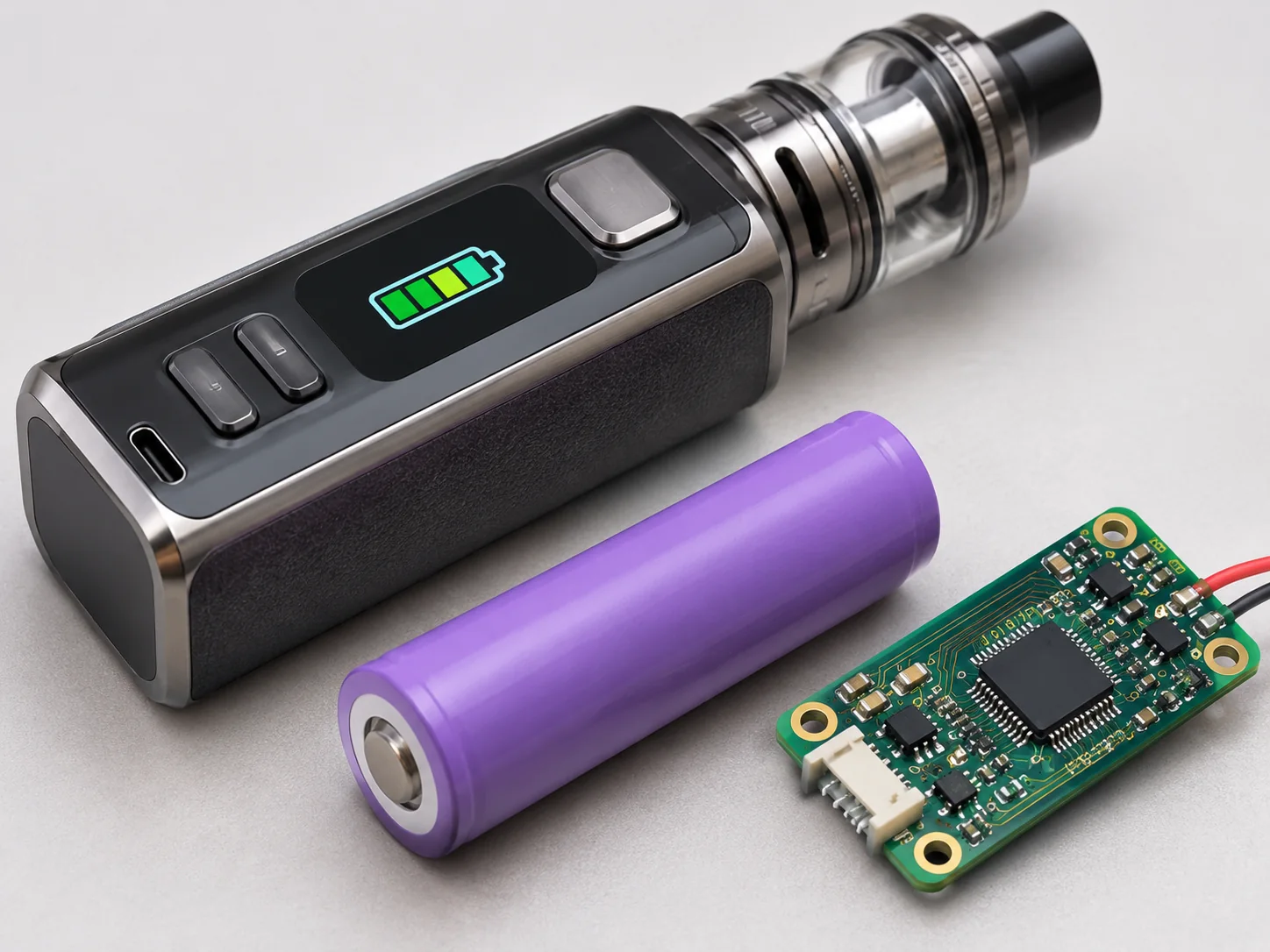
1. How does an e-cigarette calculate its battery percentage?
The percentage shown on an e-cigarette is an estimate of the remaining charge.
Depending on the model, that estimate may be based on battery voltage or on more sophisticated electronic measurements.
A lithium-ion battery does not deliver a perfectly constant voltage throughout its discharge.
In addition, the relationship between voltage and remaining charge is not linear.
This means that two devices using different estimation methods may display percentages that do not react in exactly the same way.
A display showing 50% therefore does not guarantee that half of the original battery life remains available.
The battery's condition and the way it is used also affect its actual runtime.
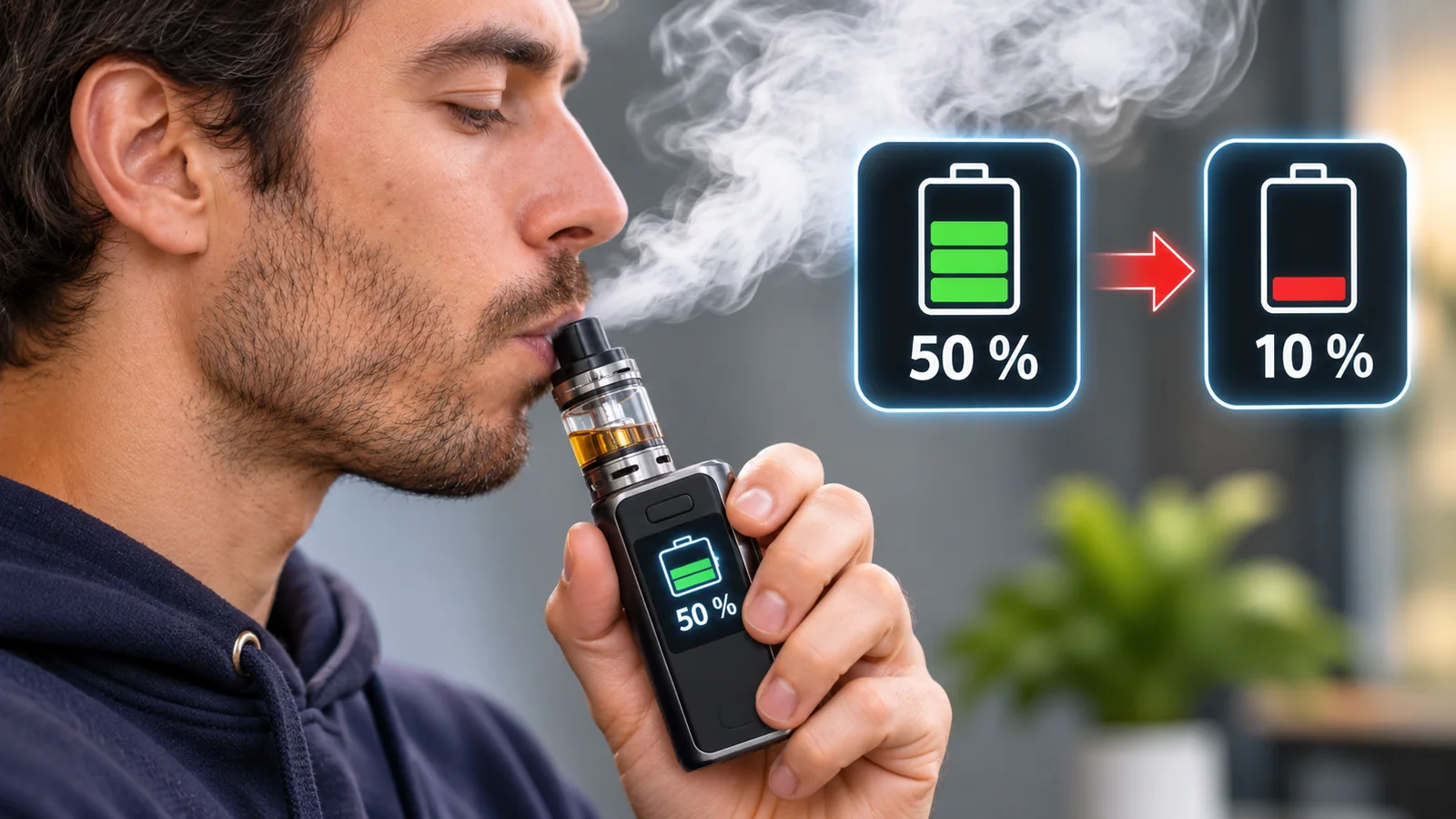
2. Why does the battery level drop while taking a puff?
When an e-cigarette operates, the coil draws energy from the battery.
This load causes a decrease in voltage known as voltage sag under load.
Its extent depends in particular on:
- The amount of current being drawn.
- The battery's internal resistance.
- Its state of charge.
- Its age.
- Its temperature.
On some devices, the display system may interpret a temporarily lower voltage as a significant drop in the remaining charge.
The indicator may then fall quickly from 50% to 10%, even though the battery has not actually lost that amount of energy in a few seconds.
This behaviour depends on the electronic circuit and does not occur on every model.
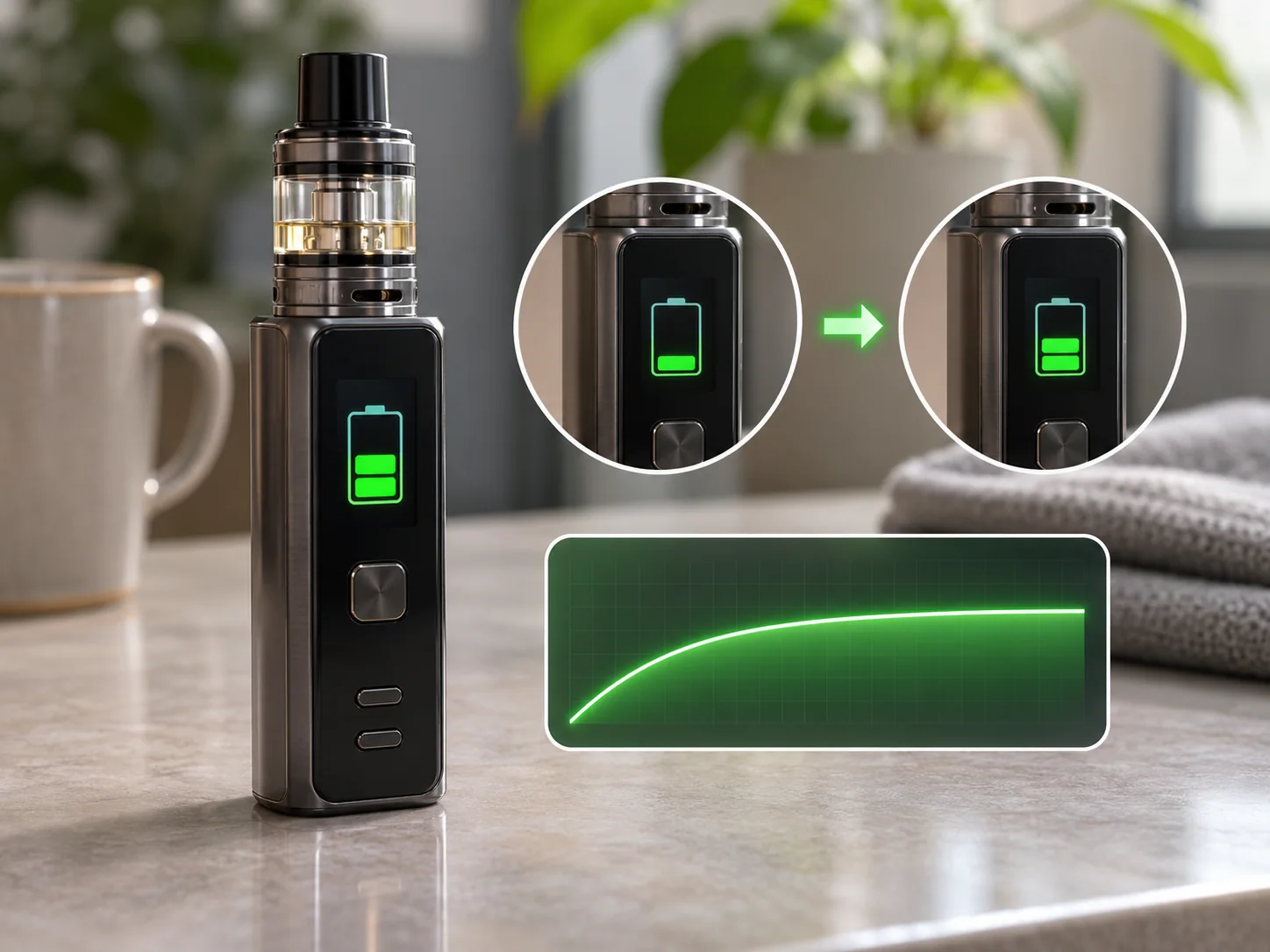
3. Why does the percentage rise again after a few seconds?
You may have noticed something surprising: the level falls to 10% while vaping, then rises to 30% or 40% when you release the button.
This variation can be explained by the partial recovery of voltage after the load is removed.
When the coil stops drawing current, the battery gradually returns to a voltage closer to its resting value.
The indicator may then revise its estimate.
This increase does not mean that the battery has recharged.
Nor does it necessarily mean that the battery is in perfect condition.
If the changes become very large, occur frequently or are accompanied by a shutdown, a possible fault should be investigated.
4. Can an ageing battery cause a sudden drop?
Yes. Lithium-ion batteries change over time and through charge cycles.
Their available capacity may decrease and their internal resistance may increase.
Higher internal resistance makes the voltage drop more pronounced when the battery supplies current.
The device may then display a very low charge level or stop operating, even though the indicator showed a substantial charge only moments earlier.
Several symptoms may accompany this ageing:
- Battery life becoming noticeably shorter.
- Large swings in the displayed percentage.
- More frequent “Low Battery” messages.
- A shutdown during a puff.
- Repeated loss of performance despite normal charging.
However, these signs alone are not enough to confirm that a battery has reached the end of its useful life.
5. Can the power setting make the problem worse?
On an e-cigarette with adjustable power, the wattage determines the electrical power requested by the heating system.
The higher the power setting, the more energy the battery generally needs to supply during activation.
This demand can increase voltage sag, particularly when the battery is already partially discharged or ageing.
However, the wattage should not be reduced arbitrarily without considering the coil manufacturer's recommendations.
Each device has its own operating ranges.
An unsuitable coil resistance, an incorrect setting or an electronic malfunction can also change the device's behaviour.
To better understand the role of settings, read our article about e-cigarette wattage changing by itself.
6. Can cold weather make the battery percentage drop?
Temperature affects the performance of lithium-ion batteries.
When the temperature falls, internal electrochemical reactions can slow down and internal resistance can increase.
A cold battery may therefore experience a greater voltage drop when it is under load.
This can temporarily reduce the available runtime or trigger a protective cut-off.
However, never use an intense heat source to try to warm up a battery.
If your device has been exposed to cold conditions, allow it to return naturally to a temperature that complies with the manufacturer's recommendations.
Do not charge it outside the temperature range permitted in its instructions.
7. Built-in batteries and removable cells: what is the difference?
How you investigate the problem depends on the type of device.
E-cigarette with a built-in battery
The battery is installed inside the device and is generally not intended to be replaced directly by the user.
An abnormal reduction in runtime may come from the cell, the battery management circuit or another internal fault.
Do not open the housing to access the battery.
Box mod with removable battery cells
Some box mods use one or more rechargeable cells, particularly the 18650 or 21700 formats.
An ageing, damaged or unsuitable cell for the device's requirements can cause inconsistent performance.
For models that use several cells, follow the manufacturer's recommendations on their compatibility and use together.
A cell with a torn insulating wrap, a deformation or signs of damage must not be used or charged.
8. How can you identify what is causing the percentage to fall?
The moment when the problem occurs is an important clue.
| Symptom observed | Possible explanation |
|---|---|
| The level drops during a puff and then rises again | Voltage sag under load and a fluctuating estimate |
| The battery runs down much faster than before | Ageing or a change in usage conditions |
| The device switches off while still showing some charge | Low-voltage protection or a malfunction |
| The percentage falls mainly in cold weather | Performance affected by temperature |
| The level drops quickly even when not in use | Abnormal self-discharge or a possible electronic fault |
This table can help guide checks, but it is not a definitive diagnosis.
A rapid loss of charge while the device is not being used, especially if it is also heating up, requires you to stop using and charging it.
9. What should you check before deciding the battery is faulty?
If the device shows no signs of danger, a few external checks may help you describe the problem more accurately.
Start by consulting your model's manual to understand how its battery gauge works.
Observe whether the percentage changes mainly during activation or also decreases while the device is at rest.
Then check that the power setting and coil used comply with the manufacturer's recommendations.
If the issue also involves charging, consult our guide to e-cigarettes that no longer charge.
Deliberately deep-discharging the battery, repeating full charge cycles or changing the device's software to try to recalibrate the gauge is not recommended.
These actions are not a universal repair method.
10. When should you stop using the e-cigarette?
A change in the displayed percentage does not necessarily represent an immediate danger.
However, certain warning signs should prompt you to stop all use or charging:
- A battery or casing that becomes unusually hot.
- Deformation or swelling.
- An unusual smell.
- Liquid entering electrical components.
- Repeated shutdowns accompanied by abnormal operation.
- A significant unexplained loss of charge while the device is at rest.
Do not attempt to open a built-in battery, repair a lithium-ion cell or bypass electronic protections.
If in doubt, have the device checked by the manufacturer or a qualified professional.
Frequently asked questions about sudden battery drops
Why does my e-cigarette drop from 50% to 10% during a puff?
Battery voltage can fall while it supplies current. Some indicators interpret that reduction as a drop in charge level. A very large or recurring change may also indicate an ageing battery.
Why does the percentage rise again when I stop vaping?
After the load ends, the battery voltage can partially recover. The device may then display a higher estimated charge. This does not mean that the battery has recharged.
Can a new battery display an incorrect percentage?
Yes. The estimation system depends on the device's electronic design. A changing gauge does not always indicate ageing, but persistent abnormal behaviour should be checked.
Does higher wattage drain the battery faster?
Under comparable conditions, higher electrical power generally requires more energy. It can also increase voltage sag under load. Settings must always comply with the manufacturer's recommendations.
Should a battery be replaced if it suddenly falls to 10%?
Not automatically. It is important to distinguish a temporary change in the gauge from a real loss of runtime or a malfunction. If the problem persists, the device should be checked before considering replacing the affected component.
Conclusion
An e-cigarette whose battery level suddenly falls from 50% to 10% does not necessarily lose 40% of its energy in a few seconds.
This behaviour can be related to a voltage drop during operation, the method used to estimate the percentage or battery ageing.
The key distinction is whether the percentage rises again after a puff or whether actual battery life continues to decline.
If the fluctuations become large, frequent or accompanied by shutdowns and faults, it is best to stop using the device and have it checked.
RoyalCig technical information article for adults. Vaping products are not risk-free. Nicotine is addictive. These products must not be used by non-smokers.