

Post author: Royalcig
Publication date: 20/11/2026
You prepare your DIY e-liquid using a base labelled 50/50 PG/VG, but after adding your flavour concentrate and nicotine boosters, the finished mixture no longer has exactly the same proportions.
You prepare your DIY e-liquid using a base labelled 50/50 PG/VG, but after adding your flavour concentrate and nicotine boosters, the finished mixture no longer has exactly the same proportions.
This difference is mathematically normal: the PG/VG ratio of the base does not necessarily match the PG/VG ratio of the finished e-liquid.
Flavour concentrates and boosters also introduce ingredients that change the composition of the mixture. To establish the final proportions, you therefore need to account for every volume added.
Here is how to understand this difference and correctly calculate the ratio of your DIY preparation.
1. What does a 50/50 PG/VG ratio actually mean?
The PG/VG ratio indicates the proportions of propylene glycol (PG) and vegetable glycerine (VG) in a liquid.
A neutral base described as 50/50 contains, in principle, 50% PG and 50% VG.
In 100 ml of this base, there are therefore:
- 50 ml of propylene glycol.
- 50 ml of vegetable glycerine.
These proportions apply only to the base before other ingredients are added.
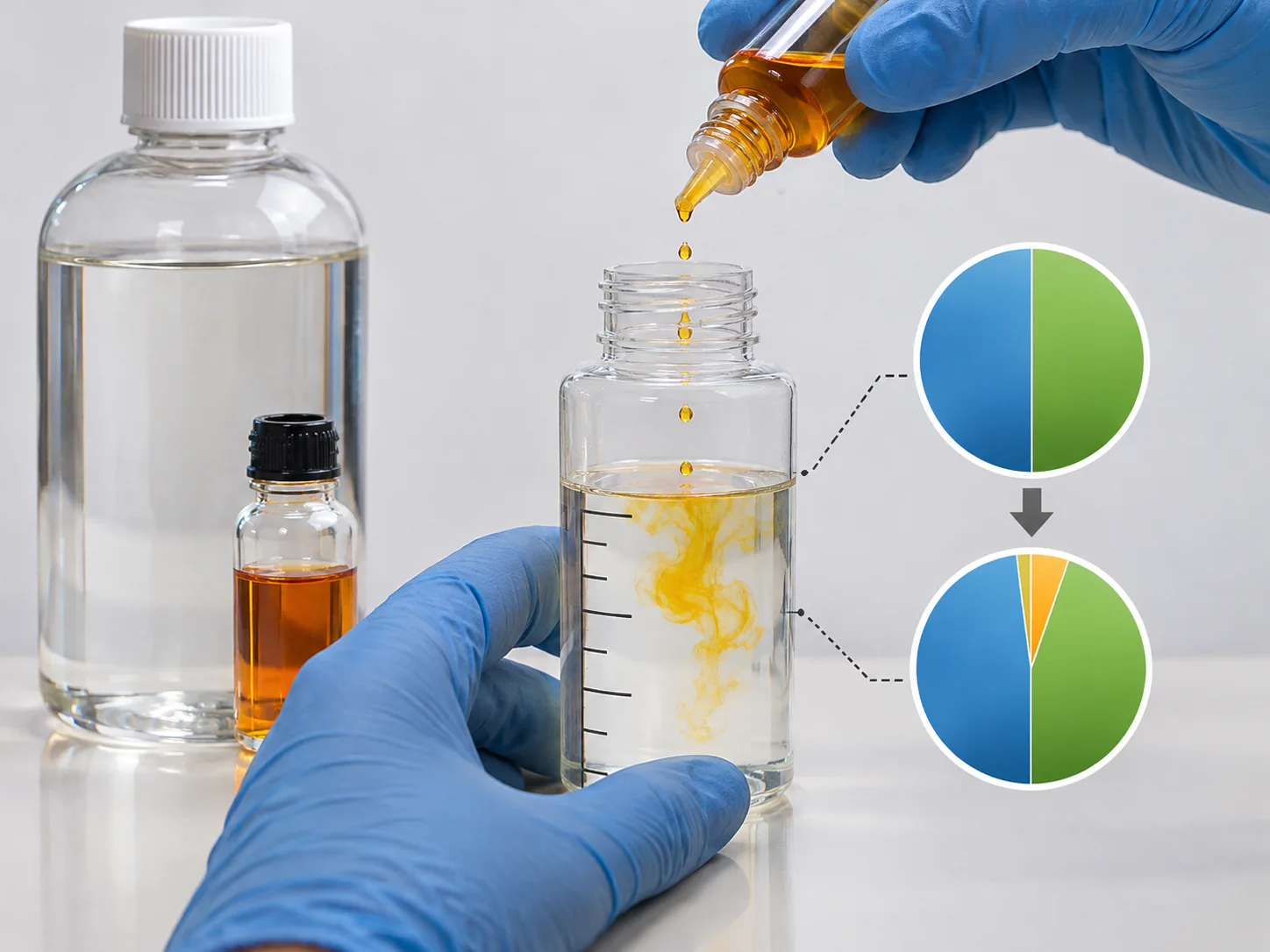
When you add a flavour concentrate or booster with a different composition, the final proportions change.
The ratio printed on the base bottle is therefore not enough, by itself, to establish the composition of the finished DIY e-liquid.
2. Why do flavour concentrates change the PG/VG ratio?
Many flavour concentrates intended for DIY e-liquids use propylene glycol as their carrier.
When a concentrate is formulated entirely with a PG carrier, every millilitre added increases the total amount of PG in the preparation.
Consider a simple example:
- 90 ml of 50/50 neutral base.
- 10 ml of flavour concentrate carried entirely in PG.
- Final volume: 100 ml.
The 90 ml of base contains 45 ml of PG and 45 ml of VG.
In this simplified example, the 10 ml of concentrate adds another 10 ml of PG.
The finished mixture therefore contains:
- 55 ml of PG.
- 45 ml of VG.
The final ratio is 55/45 PG/VG, not 50/50.
This example assumes that the entire concentrate can be counted as PG. In practice, its exact composition may also include other flavouring substances and must be checked with the manufacturer.
The result therefore remains an indicative calculation based on the declared composition of the ingredients.
3. Do nicotine boosters also change the ratio?
Yes. A nicotine booster also has a PG/VG carrier.
Some boosters are formulated at 50/50, while others have different proportions.
Their composition must therefore be included in the calculation.
Example using a base, flavour concentrate and booster
Imagine a finished preparation of 100 ml made up of:
- 80 ml of 50/50 neutral base.
- 10 ml of concentrate counted entirely as PG.
- 10 ml of 50/50 nicotine booster.
The breakdown is as follows:
| Ingredient | PG | VG |
|---|---|---|
| 80 ml of 50/50 base | 40 ml | 40 ml |
| 10 ml concentrate with PG carrier | 10 ml | 0 ml |
| 10 ml of 50/50 booster | 5 ml | 5 ml |
| Total | 55 ml | 45 ml |
The theoretical final ratio is therefore 55/45 PG/VG.
With a 10 ml booster at 20 mg/ml and a base that initially contains no nicotine, this 100 ml mixture also contains 2 mg/ml of nicotine.
This example shows why the total volume, flavour concentration, nicotine and PG/VG proportions all need to be calculated together.
4. How do you calculate the actual final PG/VG ratio?
To make the calculation, start by identifying the volume and composition of each ingredient.
The total amount of PG is the sum of the PG contributed by the base, the concentrate and any boosters.
The same principle applies to VG.
Calculation formulas
Final PG percentage:
Final PG (%) = (total PG volume ÷ final mixture volume) × 100
Final VG percentage:
Final VG (%) = (total VG volume ÷ final mixture volume) × 100
These formulas assume that the volumes can be added together and that the composition of the ingredients is known.
In a real preparation, some concentrates also contain other substances. A calculation based on the declared carrier can therefore be an approximation.
For a simple recipe, it nevertheless helps explain the differences between the original base and the finished mixture.
5. Does a 30/70 base remain 30/70 after adding flavour concentrate?
Not necessarily.
Take a 100 ml preparation containing:
- 90 ml of 30/70 PG/VG base.
- 10 ml of concentrate counted entirely as PG.
The 90 ml of base contains:
- 27 ml of PG.
- 63 ml of VG.
Adding the concentrate theoretically brings in a further 10 ml of PG.
The finished preparation then contains 37 ml of PG and 63 ml of VG.
The theoretical final ratio becomes 37/63 PG/VG.
This difference is particularly important to understand when using a VG-rich base.
You should therefore avoid assuming that a mixture remains 30/70 simply because that is the composition of its base.
6. Why does flavour dosage have such a strong effect on the result?
The greater the proportion of concentrate, the greater its potential effect on the final ratio.
With a 50/50 base and a concentrate counted entirely as PG, the following theoretical results are obtained:
| Flavour in final volume | Final PG | Final VG |
|---|---|---|
| 5% | 52.5% | 47.5% |
| 10% | 55% | 45% |
| 15% | 57.5% | 42.5% |
| 20% | 60% | 40% |
These figures are mathematical examples, not recommended dosages.
The flavour percentage must always follow the concentrate manufacturer's instructions.
You should not arbitrarily increase or decrease the dosage solely to achieve a particular PG/VG ratio.
To review the principles of dilution and steeping, see our complete guide to making DIY e-liquid.
7. Why does the final ratio matter for your device?
PG and VG have different physical properties.
Vegetable glycerine is notably more viscous than propylene glycol.
A mixture containing more VG may therefore flow differently from a liquid with a higher PG content.
Among other things, this affects the supply of liquid to the coil.
Depending on the tank design, the coil used and the manufacturer's recommendations, some ratios may be more suitable than others.
Liquid behaviour also depends on temperature and the complete formulation.
The proportions should therefore not be chosen solely on the basis of the figure stated on the neutral base.
To better understand the differences between formulations, also see our guide to choosing e-liquid.
8. Which mistakes should you avoid in DIY calculations?
The most common confusion is to calculate only the proportions of the base and leave out the other ingredients.
This can lead to several mistakes:
- Calculating flavour dosage from the volume of the base rather than the intended final volume.
- Forgetting the PG/VG contributed by boosters.
- Assuming all concentrates have exactly the same composition.
- Adding ingredients to a bottle already filled to its maximum capacity.
- Confusing the nicotine concentration of a booster with that of the finished mixture.
- Using dosage instructions intended for a different formulation.
It is also important not to handle concentrated nicotine outside the products and conditions intended for general consumer use.
Nicotine poses a risk of poisoning, particularly if swallowed or accidentally encountered.
Use suitable containers, avoid skin contact and keep preparations out of reach of children and animals.
9. Can you achieve exactly the final ratio you want?
Mathematically, it is possible to calculate the amounts needed to target a particular ratio when the composition of every ingredient is known.
However, a ready-to-use base does not always allow you to obtain any desired final proportion after adding flavourings or boosters.
It may be necessary to adjust the amounts of PG and VG used while following the intended formulation and the manufacturers' recommendations.
Such a preparation requires accurate measurements and ingredients specifically suitable for DIY use.
Any substances other than PG and VG present in the concentrates must also be taken into account.
A calculated result is therefore not necessarily an exact analytical measurement of the finished composition.
Frequently asked questions about PG/VG ratios in DIY e-liquids
Why is my DIY mixture no longer 50/50 after adding flavour concentrate?
A concentrate using PG as its carrier adds more propylene glycol. The final ratio may therefore be richer in PG than the original base.
Does a 50/50 nicotine booster change the final ratio?
It depends on the other ingredients. If every component has exactly the same 50/50 ratio, the ratio may remain unchanged. However, a flavour carried in PG can change the result.
How do you calculate the actual PG/VG of a 100 ml DIY mixture?
Add up separately the amounts of PG and VG contributed by each ingredient, then divide each total by the final volume. Multiply by 100 to obtain the percentages.
Is a 30/70 base suitable for obtaining a final 30/70 DIY mixture?
Not automatically. Concentrates and boosters can change the breakdown. You need to calculate their contributions and check the actual composition of the ingredients.
Can a calculator tell you the exact DIY ratio?
A calculator gives a result based on the information entered. Its accuracy depends on the actual composition of the ingredients and the assumptions made, particularly for flavour concentrates.
Conclusion
The PG/VG ratio stated on a neutral base does not necessarily match that of the finished DIY e-liquid.
Flavour concentrates, boosters and their different carriers change the proportions of the mixture.
To find the final ratio, calculate separately the amounts of PG and VG contributed by all the ingredients, then relate them to the total volume.
This method makes it easier to understand the theoretical composition of the preparation and avoid confusion between the base ratio and that of the finished liquid.
Manufacturers' recommendations remain essential for dosage, ingredient compatibility and device use.
RoyalCig technical information article for adults. Vaping products are not risk-free. Nicotine is addictive. These products should not be used by non-smokers.