
Post author: Royalcig
Publication date: 18/11/2026
Making e-liquid for an electronic cigarette is a practice known as DIY , short for Do It Yourself .
Making e-liquid for an electronic cigarette is a practice known as DIY, short for Do It Yourself.
It involves preparing a mixture from a neutral base, one or more flavour concentrates and, optionally, a solution containing nicotine.
But how do you calculate the right proportions? Which PG/VG base should you use? How much flavour concentrate should you add? How long does an e-liquid need to steep, and what precautions should you take?
Preparing an e-liquid requires an understanding of several essential concepts, including volumes, concentrations and ingredient compatibility.
This guide explains the technical principles of DIY, dilution calculations, preparation steps and safety rules. It is intended exclusively for adults who already use vaping products.
Important: making an e-liquid yourself does not guarantee its health-related quality or safety. Vaping carries risks, even with nicotine-free liquid.
1. What is a DIY e-liquid?
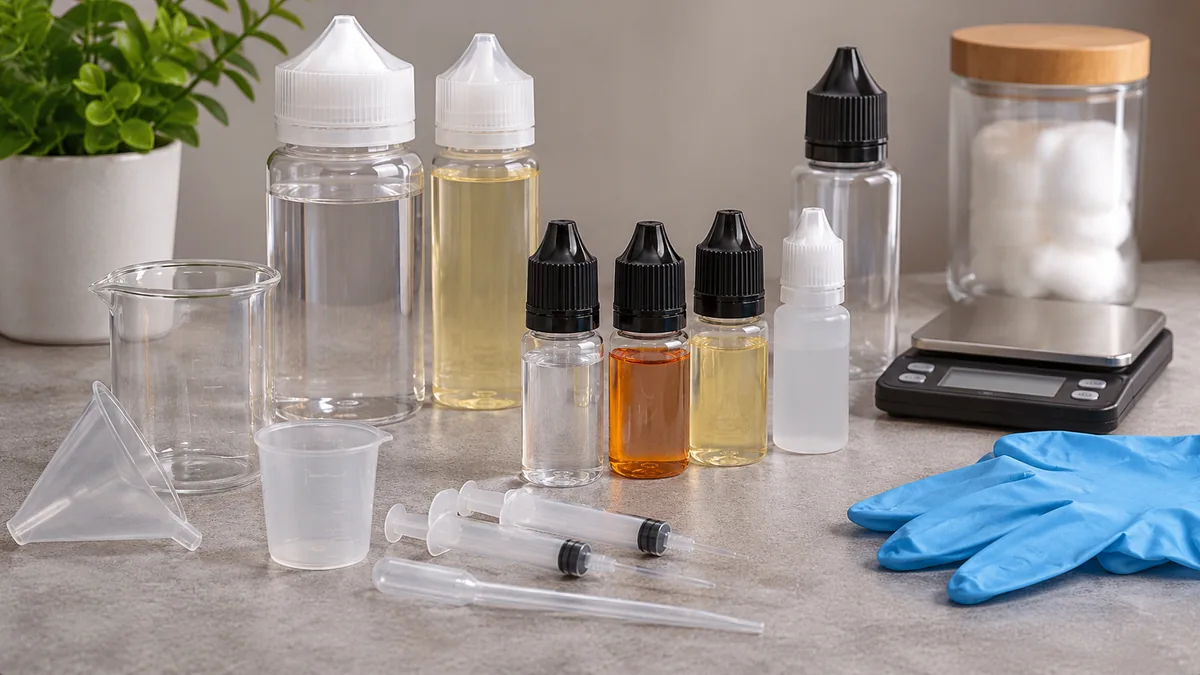
A DIY e-liquid is a preparation made by the user from several components.
Unlike ready-to-use e-liquid, the ingredients are combined separately.
A typical preparation contains three elements:
- A neutral PG/VG base, making up most of the liquid.
- A flavour concentrate, intended to provide flavour characteristics.
- A nicotine booster, optional and used only when a nicotine concentration is required.
The proportions of these ingredients must be calculated according to the desired final volume.
In particular, the volume contributed by each ingredient must be taken into account: adding concentrate or booster to a bottle that is already full increases the total volume and changes the concentrations.
Home preparation is not automatically subject to the same composition and quality controls as an industrially produced preparation.
2. What ingredients are used to make e-liquid?
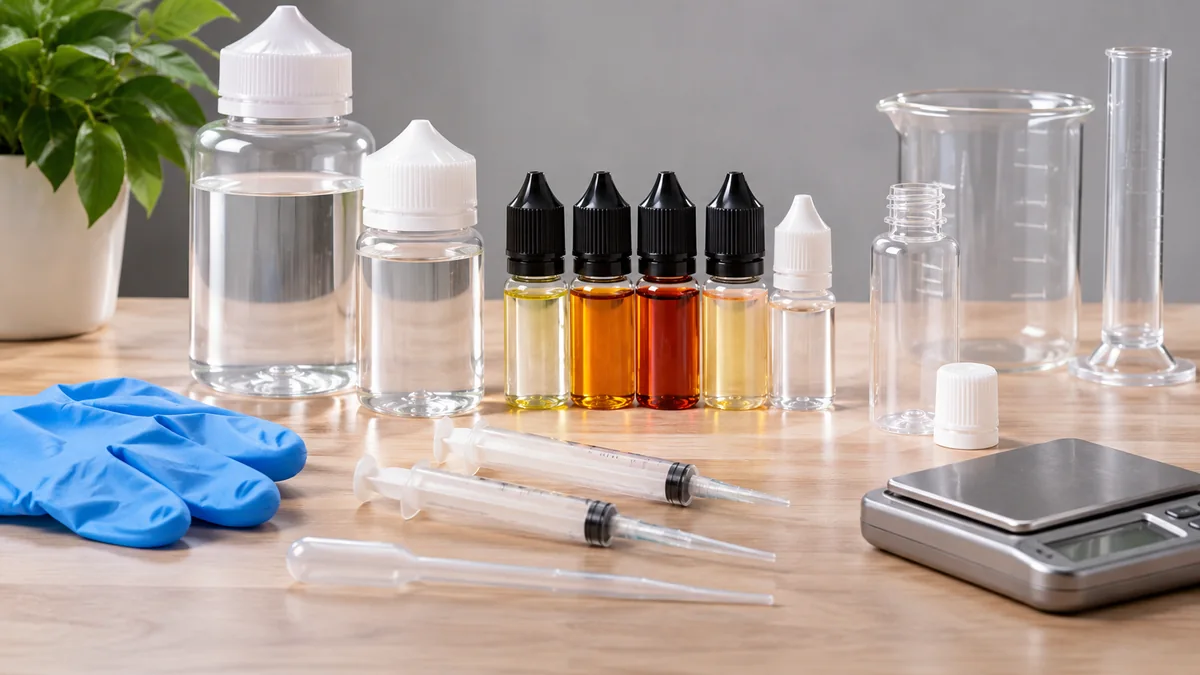
The neutral PG/VG base
The neutral base generally makes up most of the mixture.
It contains propylene glycol (PG), vegetable glycerine (VG), or a combination of the two.
Propylene glycol (PG) is relatively thin. Among other things, it acts as a carrier for flavourings and contributes to certain sensations experienced when inhaling.
Vegetable glycerine (VG) is more viscous. It contributes to aerosol formation when heated.
Bases are available in different ratios, for example:
| PG/VG base | Main characteristic |
|---|---|
| 70/30 | Relatively thin |
| 50/50 | Medium viscosity |
| 30/70 | Higher vegetable glycerine content |
| 20/80 | Very high VG content; more viscous |
The ratio must be compatible with the design of the coil used and the way liquid is supplied to it.
Warning: if the flavour concentrate contains PG and the booster has its own ratio, the PG/VG proportions of the finished mixture may differ from those of the neutral base used.
Flavour concentrates for DIY
A flavour concentrate intended for DIY is a flavouring preparation designed to be diluted.
It must not be confused with ready-to-vape e-liquid.
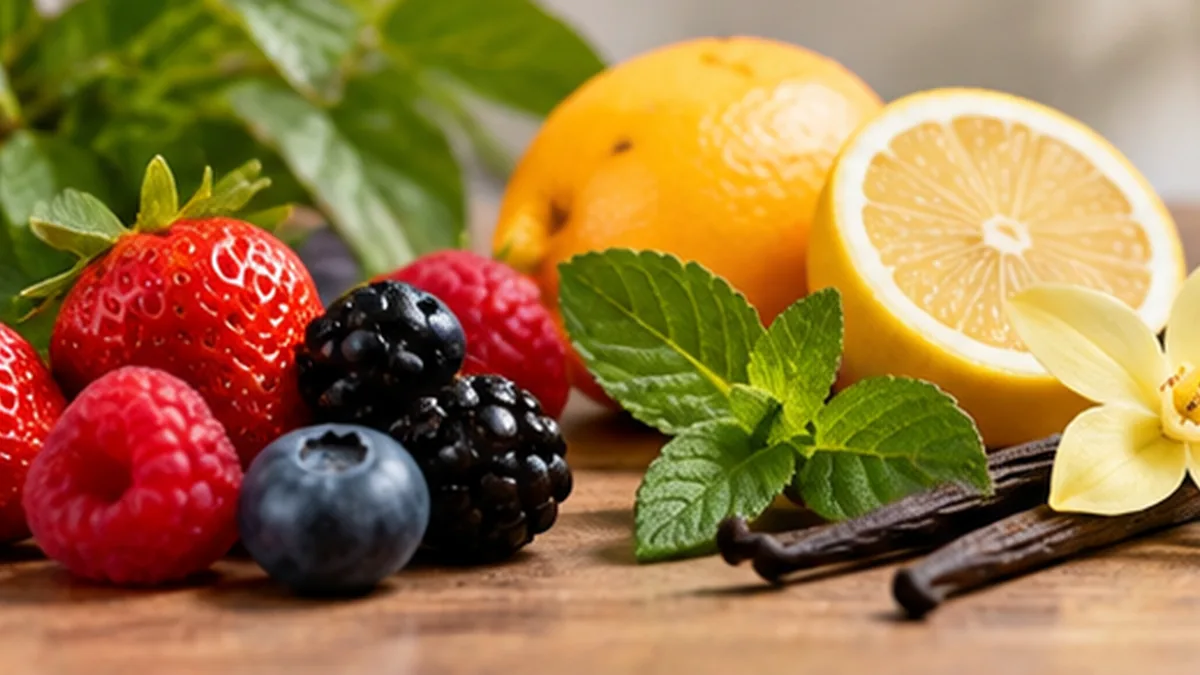
Flavours may belong to several families: tobacco, fruity, menthol, dessert-style or complex blends.
Each concentrate has its own dilution recommendations.
It is essential to follow the manufacturer's instructions and never assume that an ordinary food flavouring is suitable for inhalation.
Essential oils, edible oils, perfumes and other substances not intended for making e-liquids must not be added.
Nicotine boosters
A booster is a preparation containing nicotine, generally diluted in PG, VG or a mixture of the two.
In France, boosters sold to consumers are available, among other formats, in 10 ml bottles, with concentrations of up to 20 mg/ml.
A 10 ml booster at 20 mg/ml contains a total of 200 mg of nicotine.
Nicotine is addictive and toxic when exposure is excessive. Handling it requires special precautions to avoid skin contact and accidental ingestion.
Concentrated nicotine solutions not intended for the general public should not be used.
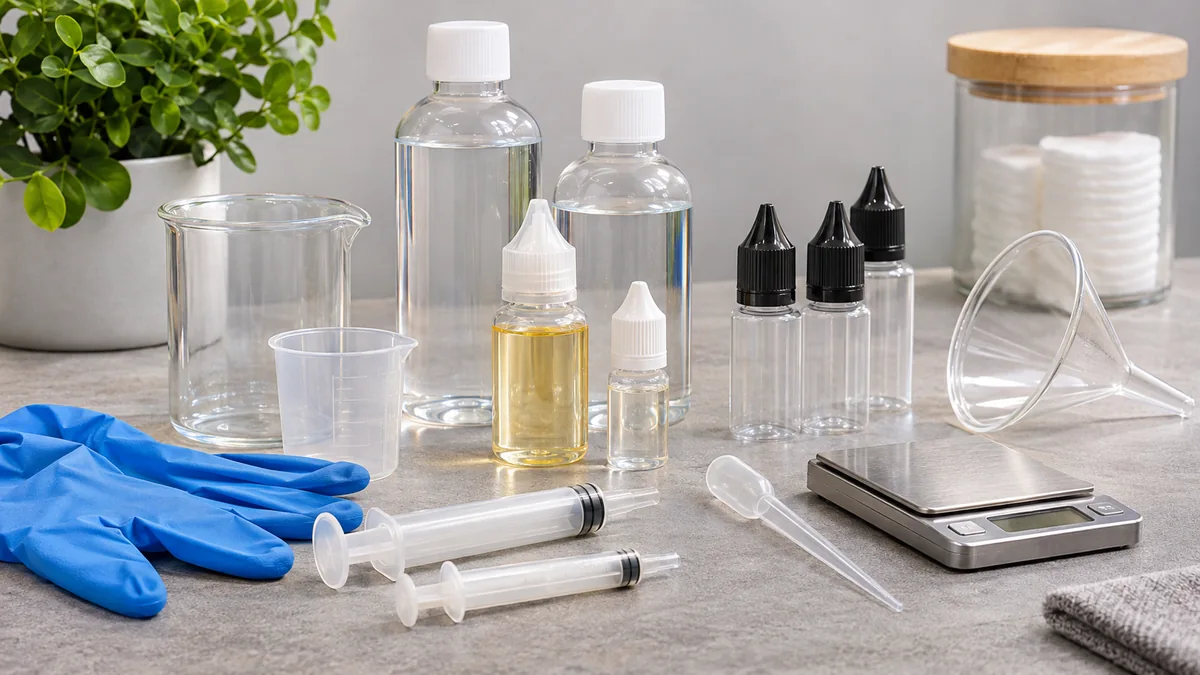
3. What equipment is needed to prepare DIY e-liquid?
Accurate measurement is important to avoid concentration errors.
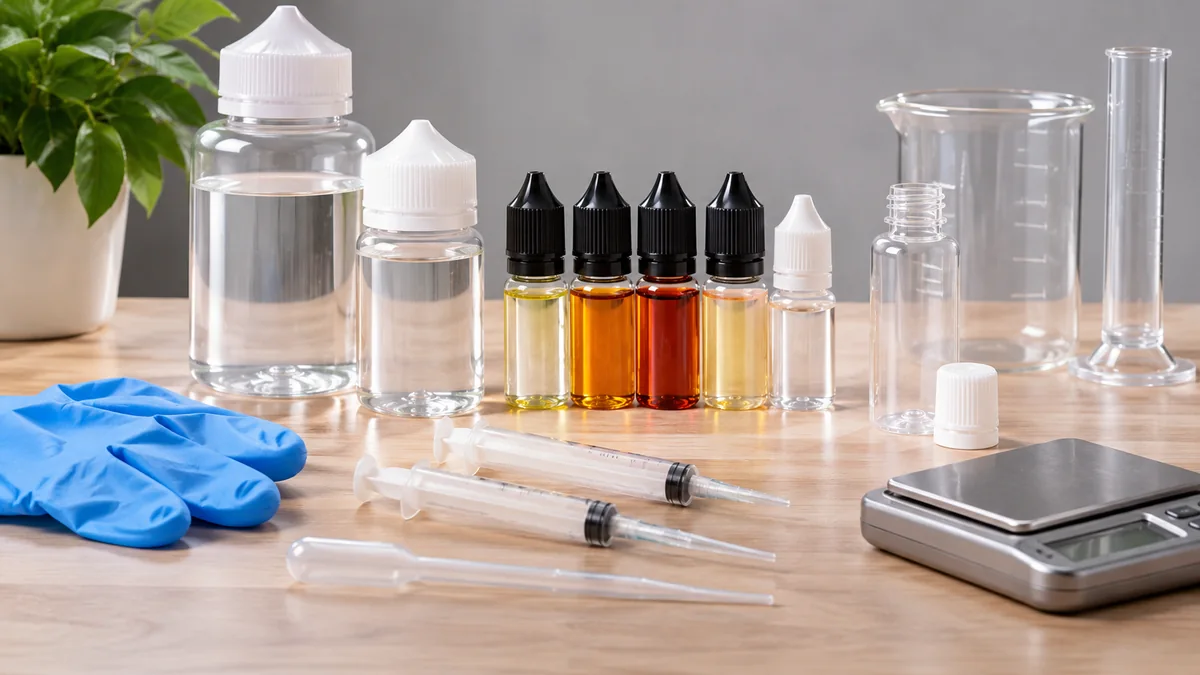
Equipment may include:
- An empty bottle compatible with the ingredients, clean and in good condition.
- A secure cap, particularly for a nicotine-containing mixture.
- A graduated syringe or pipette suitable for measuring in millilitres.
- Gloves resistant to the substances handled, particularly nitrile gloves.
- Protective eyewear when handling nicotine.
- A clean, stable, easy-to-clean work surface.
- A label for identifying the preparation.
Work must be carried out away from children, animals, food and drinks.
Tools used for the preparation must not be reused for food preparation.
Using scales requires knowledge of the density of each component. A quantity measured in grams does not automatically correspond to the same number of millilitres.
4. How do you calculate the amount of flavour concentrate?
The amount of a DIY flavour concentrate is generally expressed as a percentage of the final volume.
This percentage depends on the concentrate and its manufacturer's instructions.
For example, a flavour might have a recommended rate of 5%, 7%, 10% or 15%. These values are examples for calculation, not recommendations that apply to every concentrate.
The calculation formula
Flavour volume (ml) = Final volume (ml) × Flavour percentage ÷ 100
Example for a final preparation of 100 ml:
| Flavour percentage | Flavour volume |
|---|---|
| 5% | 5 ml |
| 7% | 7 ml |
| 10% | 10 ml |
| 12% | 12 ml |
| 15% | 15 ml |
If the manufacturer recommends 10%, a final 100 ml preparation therefore contains 10 ml of concentrate.
For a nicotine-free preparation, the remaining 90 ml can consist of a suitable neutral base.
It is important not to confuse 100 ml of base to which 10 ml of flavour is added with 100 ml of finished preparation containing 10 ml of flavour.
In the first case, the final volume is 110 ml and the flavour percentage is no longer 10%.
5. How do you calculate nicotine in DIY e-liquid?
The nicotine calculation is based on the total amount of nicotine added to the mixture and the final volume obtained.
Concentration is expressed in milligrams per millilitre, or mg/ml.
Understanding the formula
When the booster is the only nicotine-containing ingredient:
Final concentration = (Booster concentration × Booster volume) ÷ Final volume
Consider a purely mathematical example.
A 10 ml booster containing 20 mg/ml provides 200 mg of nicotine.
If those 200 mg are distributed through a final volume of 60 ml:
200 ÷ 60 = approximately 3.33 mg/ml
The theoretical final concentration is therefore about 3.33 mg/ml.
This calculation assumes accurately measured volumes and that the other ingredients contain no nicotine.
Illustrative example of how volumes are divided
To understand final volume, consider a theoretical 60 ml mixture with flavour at 10% and one 10 ml booster at 20 mg/ml.
| Component | Volume |
|---|---|
| Nicotine-free neutral base | 44 ml |
| Flavour concentrate at 10% | 6 ml |
| Booster at 20 mg/ml | 10 ml |
| Final volume | 60 ml |
The theoretical nicotine concentration is approximately 3.33 mg/ml.
This is not a recommended concentration or a recipe suitable for all users.
Dependence level, device and individual characteristics must be considered when an adult smoker uses nicotine.
A calculation or measurement error can result in a concentration different from the one expected.
6. How do you prepare DIY e-liquid step by step?
Preparation should be carried out only with identified, compatible components accompanied by the information needed for their use.
Step 1: determine the final volume
Before starting, establish precisely the total amount of liquid required.
The container used must have enough capacity to hold the mixture without overflowing.
Step 2: check the flavour instructions
Read the manufacturer's recommendations for dilution percentage, PG/VG ratio and any specific precautions.
The amount of a flavour cannot be determined solely from its flavour family.
Step 3: calculate the individual volumes
Add together the volumes of base, flavour and, if necessary, booster.
The sum must equal the planned final volume.
Any change in quantity may affect the nicotine concentration and flavour percentage.
Step 4: prepare a safe work area
The surface must be clean, clear and away from food.
Measuring equipment must be suitable and the necessary protection must be worn, especially when handling nicotine.
Step 5: measure and combine the components
Volumes are measured separately before being transferred to a compatible bottle.
Do not use any component with damaged packaging, uncertain identification or an unusual defect.
Avoid splashes and actions that could cause contact with the skin or eyes.
Step 6: make the preparation homogeneous
Once the bottle has been closed properly, the mixture can be homogenised according to the instructions for the components used.
There is no need to heat the liquid. Uncontrolled temperature increases can alter its composition or encourage the degradation of certain ingredients.
Step 7: identify the bottle
The preparation must be clearly labelled.
Useful information includes:
- The preparation date.
- The final volume.
- The ingredients used.
- The calculated PG/VG ratio.
- The theoretical nicotine concentration, if applicable.
- The flavour name or reference and its percentage.
The information should be precise enough to prevent confusion with another preparation.
7. How long should a DIY e-liquid be left to steep?
Steeping, also called maturation, is the period during which a preparation is left to rest after mixing.
In DIY practice, it mainly aims to allow the preparation to become homogeneous and its sensory characteristics to develop.
The time stated depends on the composition and manufacturer's recommendations.
Fruity flavours
Some fruity preparations have relatively short recommended steeping periods.
Other, more complex blends may need longer according to the manufacturer's instructions.
Menthol and cooling flavours
Some menthol formulations may show their sensory characteristics quickly after preparation.
This does not remove the need to follow the dilution and steeping instructions applicable to the product.
Dessert-style flavours
Concentrates containing several flavour notes may have longer recommended steeping periods.
Tobacco flavours
Tobacco-style formulations vary greatly in composition. Some contain complex blends for which the manufacturer may advise an extended resting period.
There is no universal period that guarantees a DIY e-liquid has been prepared correctly.
Steeping cannot neutralise unsuitable ingredients, correct excessive nicotine concentration or guarantee that a mixture is harmless.
The bottle must remain properly closed and stored under the recommended conditions.
8. Why does the PG/VG ratio change during preparation?
A common mistake is to assume that starting with a 50/50 base automatically produces a final 50/50 e-liquid.
That is not always the case.
If a concentrate consists mainly of propylene glycol, adding it increases the proportion of PG in the mixture.
Similarly, a nicotine booster may have a PG/VG ratio that differs from that of the neutral base.
To know the final ratio, all components and their exact composition must therefore be taken into account.
Without sufficiently accurate information about the ingredients, the final PG and VG proportions cannot be calculated rigorously.
This ratio must be compatible with the coil and liquid supply system of the electronic cigarette.
9. Can you mix several DIY flavours?
Some concentrates contain a single flavour, while others already combine several flavouring substances.
Mixing several concentrates changes the final formulation.
In particular, consider:
- The amount of each concentrate.
- The total quantity of flavouring substances.
- Any ingredients the concentrates may share.
- The final PG/VG ratio.
- The manufacturers' instructions and restrictions.
Combining several flavours at their individual maximum recommended amounts can produce a high total concentration.
Undocumented blends also introduce extra uncertainty about substances released when heated.
Two flavours working well together in taste does not guarantee their safety when combined and then inhaled.
10. How should DIY e-liquid be stored?
An e-liquid prepared at home must be stored carefully.
The bottle must remain properly closed in a suitable place, away from excessive temperatures and prolonged exposure to light.
In particular:
- Keep mixtures in clearly identified containers.
- Avoid all food containers.
- Keep products out of reach of children and animals.
- Check caps and bottles regularly for damage.
- Follow the storage instructions for the individual ingredients.
- Do not use a preparation whose identity or composition is uncertain.
A colour change alone is not sufficient to determine whether a liquid is suitable for use.
Conversely, a normal appearance does not prove that it is safe.
No universal shelf life can be guaranteed for a DIY preparation without information about its ingredients, preparation conditions and stability.
11. Common mistakes when making e-liquid
Confusing base volume with final volume
Adding flavour or booster to a bottle that is already full changes the proportions of the mixture.
All volumes must be included in the final calculation.
Using a flavour not intended for vaping
A food flavouring, essential oil or extract intended for another use may present risks when heated and inhaled.
Exceeding the recommended concentration
Excessive flavour concentration does not guarantee a better result and can increase exposure to substances in the concentrate.
Overlooking nicotine precautions
Nicotine can cause poisoning through incorrect handling, accidental ingestion or excessive exposure.
Confusing millilitres and milligrams
A millilitre is a measure of volume.
A milligram is a measure of mass.
The mg/ml concentration relates these two quantities and must not be confused with the total quantity of nicotine in a bottle.
Heating the mixture to speed up steeping
Uncontrolled heating can change the ingredients or encourage their degradation.
It must not be used as a way to guarantee or accelerate the safety of a preparation.
Failing to label preparations
Lack of identification can cause confusion between nicotine-free liquids, nicotine-containing mixtures and flavour concentrates.
12. What precautions should be taken with nicotine?
Nicotine is addictive and can be toxic.
Handling it requires particular care, especially around children.
Avoid contact with the eyes, skin and mucous membranes, use suitable protection and follow the safety instructions on the packaging.
In case of accidental skin contact, remove contaminated clothing and rinse thoroughly with water.
If swallowed, do not induce vomiting and seek prompt advice from a poison control centre.
Symptoms such as nausea, vomiting, dizziness, palpitations or feeling unwell may indicate poisoning.
If severe symptoms occur, contact emergency services.
It is preferable not to prepare a nicotine-containing mixture if the necessary safety conditions cannot be met.
Finally, making e-liquid yourself does not remove the health risks of vaping.
13. FAQ: common questions about DIY e-liquid
A nicotine-free preparation usually consists of a PG/VG base and a suitable flavour concentrate. Quantities must be calculated according to the final volume and the amount stated by the manufacturer.
The amount depends on the concentrate. As a mathematical example, 10% corresponds to 10 ml of flavour in 100 ml of finished preparation. The actual applicable percentage must be checked against the manufacturer's instructions.
The amount depends on booster strength, final volume and the theoretical concentration sought. Because nicotine is addictive and potentially toxic, the amount should not be determined without considering the user's circumstances and the necessary precautions.
The choice depends on the device design, the coil manufacturer's recommendations and the characteristics of the other ingredients. The final ratio after mixing must also be considered.
The period depends on the concentrate and its manufacturer's instructions. Steeping is not a method for making an incorrectly dosed preparation or one containing unsuitable ingredients safe.
A flavour suitable for food must not automatically be assumed to be suitable for inhalation. An ingredient may behave differently when heated and inhaled.
Possible causes include insufficient liquid reaching the coil, unsuitable viscosity, excessive power or a damaged coil. Stop using the device until the problem is identified.
Several concentrates can technically be combined, but this changes the composition and may increase uncertainty about emitted substances. Individual concentrations must not simply be added together without assessing the overall formulation.
There is no universal shelf life for a DIY mixture. It depends on the ingredients, their stability, preparation quality and storage conditions.
No general rule establishes that DIY preparation carries fewer risks. Home preparation can introduce dosing errors and additional uncertainty about the mixture's composition.
Conclusion: understand ingredients and concentrations before preparing anything
Making DIY e-liquid requires an understanding of PG/VG base composition, flavour percentages, nicotine concentrations and final-volume calculations.
Accurate measurement and following manufacturers' instructions are essential.
Preparation must also take place under suitable conditions, with particular care when handling and storing nicotine.
Finally, DIY should not be regarded as a way to obtain a risk-free product.
People who do not smoke should not start vaping. For adults wishing to stop smoking, a healthcare professional or smoking-cessation specialist can offer suitable support.