

Post author: Royalcig
Publication date: 20/11/2026
You enjoy the flavour of your nicotine-free e-liquid, but notice a difference after adding a nicotine shot? The flavours seem less noticeable, the sensation in your throat becomes stronger, or certain flavour notes seem different.
You enjoy the flavour of your nicotine-free e-liquid, but notice a difference after adding a nicotine shot? The flavours seem less noticeable, the sensation in your throat becomes stronger, or certain flavour notes seem different.
Adding nicotine can indeed change how an e-liquid is perceived. But this change does not come from nicotine alone: the increased volume, dilution of flavourings, the composition of the shot and the characteristics of the device may also play a part.
Why do these differences occur? Are they inevitable? Here are the technical explanations to understand what happens inside the bottle.
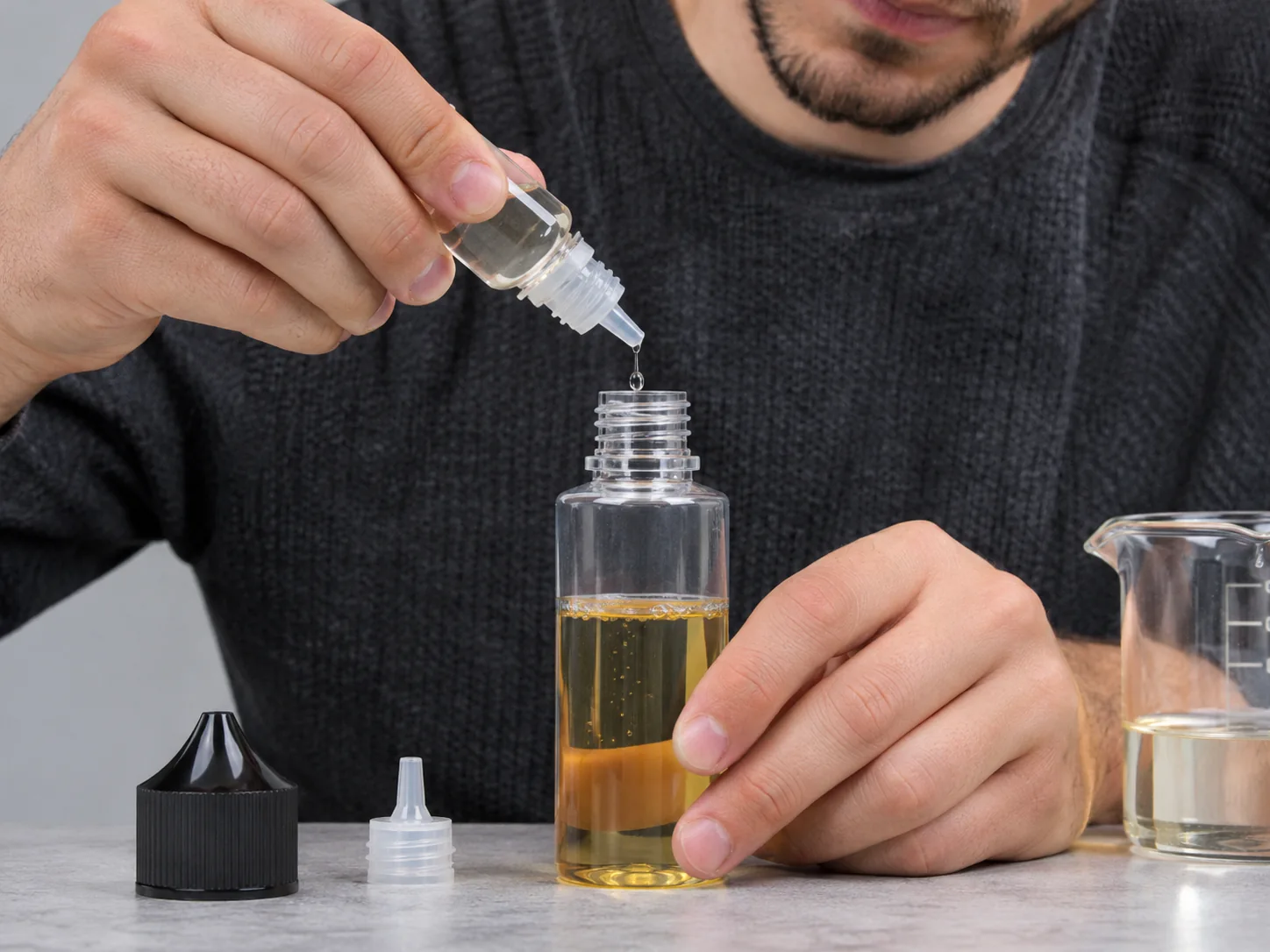
1. Does nicotine directly change the flavour of an e-liquid?
Nicotine is not a food flavouring intended to give an e-liquid a particular taste. However, it has chemical and sensory properties that can influence how the mixture is perceived.
Depending on its concentration, chemical form and the liquid's formulation, it can contribute to a stronger or more irritating feeling in the mouth and throat.
This sensation is commonly called a "throat hit" or "hit".
However, two distinct effects need to be considered:
- Flavour perception: sensations associated with flavourings, such as fruity, minty or sweet notes.
- Throat sensation: the intensity felt during inhalation, which depends in particular on nicotine, PG/VG and vaporisation conditions.
These effects can combine. A liquid may retain a flavouring composition close to the original while producing a different impression after nicotine has been added.
2. Why can flavours seem weaker after adding a nicotine shot?
Dilution is one of the simplest explanations.
A standard nicotine shot generally contains nicotine diluted in a carrier made of propylene glycol (PG), vegetable glycerine (VG), or both.
If it contains no flavouring, adding it increases the mixture's total volume without increasing the amount of flavour compounds.
The flavour concentration therefore decreases.
Example with 50 ml of e-liquid
Take a bottle containing 50 ml of nicotine-free e-liquid.
After adding a 10 ml nicotine shot at 20 mg/ml, the total volume reaches 60 ml.
The original quantity of flavourings stays the same, but it is now distributed throughout 60 ml instead of 50 ml.
The initial flavour concentration therefore falls by approximately 16.7%.
The final mixture also contains approximately 3.3 mg/ml of nicotine, assuming the starting liquid contained 0 mg/ml.
This reduction in concentration does not mean that perceived flavour intensity falls by exactly the same proportion.
Some manufacturers adjust the flavour concentration of their products intended for nicotine shots to account for the extra volume.
The outcome therefore depends on the original formulation and the instructions specific to the product.
3. Can the shot's PG/VG ratio change the sensations?
Propylene glycol and vegetable glycerine do not have exactly the same physical properties.
PG is notably less viscous than VG. Their proportions affect liquid supply to the coils, aerosol formation and certain sensations during inhalation.
When a nicotine shot has a different PG/VG ratio from the original liquid, the final proportions change.
For example, adding a 50/50 shot to a liquid containing more VG slightly changes its overall composition.
The extent of this change depends on how much is added.
It is therefore preferable to check both the shot's composition and that of the liquid before mixing.
A change in ratio does not automatically mean flavours will be less noticeable. It may nevertheless affect vaporisation conditions and, consequently, the sensations perceived.
4. Freebase nicotine and nicotine salts: how do the sensations differ?
Nicotine can be present in e-liquids in different chemical forms.
In particular, a distinction is made between conventional nicotine, known as freebase, and formulations using nicotine salts.
These forms can produce different sensations even when their total nicotine concentrations are identical.
Studies of sensory perception show, among other things, that the form of nicotine and the chemical characteristics of a liquid can influence irritation and throat sensation.
Nicotine salts do not, however, guarantee an absence of irritation or better tolerance.
Furthermore, not all nicotine shots are interchangeable.
The manufacturer's recommendations must be followed and the formulation's compatibility with the device must be checked.
Flavour perception remains subjective and also depends on the flavourings and vaporisation conditions.
5. Why can an e-liquid turn yellow after nicotine is added?
A change in colour may occur after nicotine is added to an initially clear e-liquid.
The mixture may gradually take on a yellow, golden or amber hue.
This change may be linked, among other things, to nicotine oxidation, which is encouraged by exposure to oxygen, light and heat.
The speed of the process varies according to the formulation and storage conditions.
The liquid's colour must be distinguished from its flavour intensity.
An e-liquid that has become darker does not necessarily have a stronger flavour.
Conversely, flavour can change without any visible change in colour.
Colour also cannot establish whether a product remains suitable for use. An unusual smell, particles or separation of the mixture call for additional precautions.
6. Does the flavour change immediately after mixing?
After adding a nicotine shot, it is important that the ingredients are properly distributed throughout the bottle.
Mixing should take place in a suitable container with enough capacity for the full volume.
Close the bottle securely and follow the manufacturer's mixing instructions.
Appropriate shaking can help make the mixture homogeneous.
However, homogenisation and steeping are different processes.
Should e-liquid be left to steep after adding nicotine?
Steeping is generally discussed in DIY preparations, particularly when concentrated flavourings are incorporated into a base.
It may allow certain flavour characteristics to develop over time.
However, adding a nicotine shot to an already formulated e-liquid does not systematically require prolonged steeping.
Recommendations depend on the manufacturer and the product concerned.
Waiting several days does not automatically correct an overly diluted mixture or an unsuitable formulation.
To understand the different stages of preparation, consult our guide to making DIY e-liquids.
7. Why do some e-liquids accommodate a nicotine shot better than others?
Not all formulations are identical.
Some nicotine-free e-liquids, often supplied in partially filled bottles, are specifically designed to allow one or more nicotine shots to be added.
The manufacturer may adjust their flavour concentration to account for the intended final volume.
Other preparations are not designed to have extra liquid added.
The difference depends on several factors, including:
- The original flavour concentration.
- The intended volume of nicotine shot.
- The ingredients' PG/VG ratio.
- The formulation of the flavourings.
- The recommended preparation conditions.
Having spare space in a bottle does not necessarily mean any quantity of nicotine shot can be added.
The manufacturer's instructions remain the reference for the intended final volume.
8. How can excessive dilution of flavours be avoided?
The first precaution is to know the total volume you want to obtain.
It is also necessary to check the concentration of the shot and that of the original liquid.
For nicotine-free e-liquid, the final concentration can be calculated from the amount of nicotine added and the mixture's total volume.
In particular, keep the following points in mind:
- Do not exceed the bottle's capacity.
- Follow the volumes recommended by the manufacturer.
- Check the ingredients' PG/VG ratio.
- Do not confuse a nicotine shot with a concentrated flavouring.
- Avoid adding ingredients whose compatibility is unknown.
Trying to compensate for excessive dilution by improvising with extra concentrated flavourings is not recommended.
These preparations must follow the manufacturers' dosage guidance.
To understand the differences between formulations and formats, consult our guide to choosing an e-liquid.
9. Can the device make flavour differences more noticeable?
Two slightly different mixtures will not necessarily be perceived in the same way with every electronic cigarette.
Power, coil, airflow and the characteristics of the vaporisation system influence aerosol formation.
A dirty coil may also alter how flavours are delivered.
A change in flavour should therefore not automatically be attributed solely to the addition of nicotine.
If the flavour seems unusual, check in particular:
- The condition of the coil.
- The recommended power for the device.
- The suitability of the PG/VG ratio.
- The absence of burnt taste or overheating.
- The liquid's storage conditions.
If an abnormality persists, it is preferable to stop using the device and consult the manufacturer's instructions.
Frequently asked questions about e-liquid flavour after adding nicotine
Why does my e-liquid have less flavour after adding a nicotine shot?
An unflavoured shot increases the mixture's volume without increasing the quantity of flavourings. Their concentration may therefore decrease. The extent of the difference depends on the volume added and the original formulation.
Does nicotine give e-liquids a particular taste?
Nicotine can influence perceived sensations, particularly throat intensity and certain taste impressions. Its effect depends on concentration, chemical form and the liquid's composition.
Why does my e-liquid turn yellow after adding nicotine?
Yellow or amber colouring may appear, among other reasons, as a result of chemical changes in nicotine, including oxidation. This change alone cannot establish the liquid's quality or safety.
Should e-liquid be left to rest after adding a nicotine shot?
Follow the manufacturer's instructions and ensure the mixture is properly homogeneous. Prolonged steeping is not systematically necessary when a shot is added to an already formulated e-liquid.
Can I add more flavouring if the taste becomes too weak?
Improvising with extra concentrated flavourings is not recommended. Excessive concentration or an incompatible formulation can cause problems. The manufacturer's dosage and instructions must be followed.
Conclusion
Adding nicotine can change the perceived flavour of an e-liquid for several reasons.
Dilution of flavourings, possible changes to the PG/VG ratio and nicotine's sensory properties can all contribute to this difference.
The mixture's colour may also evolve, particularly towards yellow or amber tones, without this necessarily corresponding to any change in flavour intensity.
The key distinction is therefore between flavour concentration, throat sensation and chemical changes in the liquid.
To understand the changes observed, the full formulation, the proportions used and the vaporisation conditions must all be considered.
RoyalCig technical information article for adults. Vaping products are not risk-free. Nicotine is addictive. These products should not be used by non-smokers.