
Post author: Royalcig
Publication date: 20/11/2026
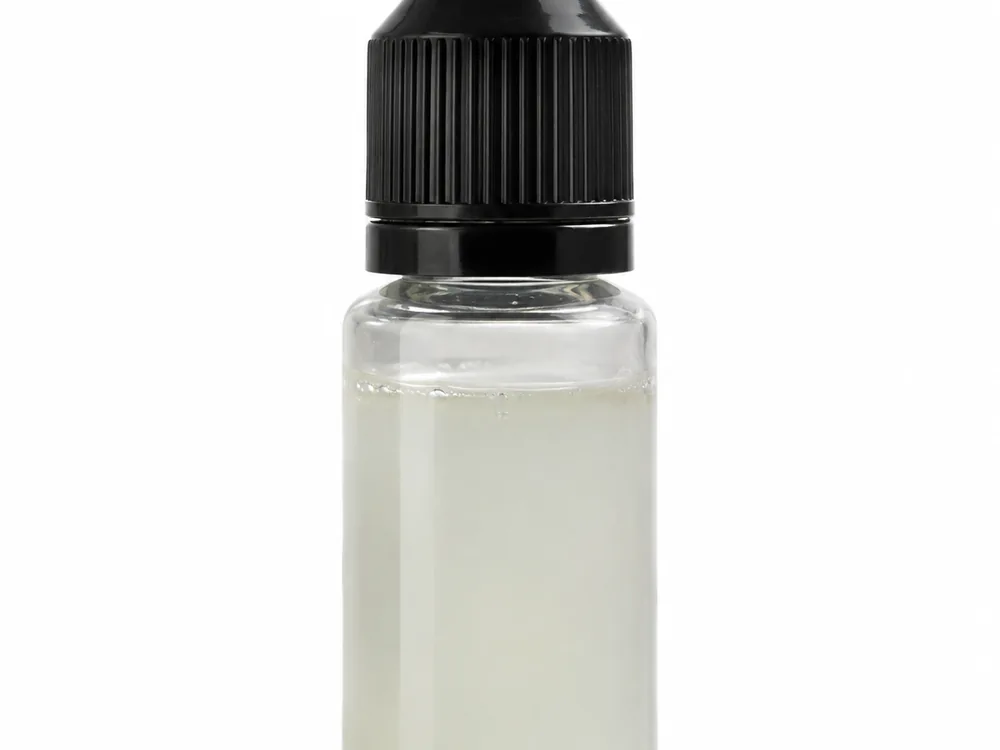
Have you noticed that your e-liquid, usually clear, now looks cloudy, milky or slightly opaque? This change may occur in a new bottle, after several weeks in storage or following exposure to cold temperatures.
Have you noticed that your e-liquid, usually clear, now looks cloudy, milky or slightly opaque? This change may occur in a new bottle, after several weeks in storage or following exposure to cold temperatures.
Why does e-liquid become cloudy? Several processes may explain the change: temperature, ingredient solubility, changes in flavourings, or separation of the mixture's components.
Cloudy liquid is not necessarily contaminated, but its appearance alone cannot guarantee that it is still suitable for use. Here is how to understand the possible causes and recognise situations that require caution.
1. What does cloudy e-liquid mean?
E-liquid generally contains propylene glycol (PG), vegetable glycerine (VG), flavourings and, depending on the formulation, nicotine.
These ingredients are combined to form a normally homogeneous preparation whose appearance depends on its composition.
Some liquids are perfectly clear. Others naturally have a slightly yellow or amber colour, or a particular appearance linked to their ingredients.
Cloudy e-liquid may appear in several ways:
- A milky or whitish appearance.
- A diffuse haze throughout the bottle.
- Small visible suspended particles.
- Sediment at the bottom of the container.
- Two apparently distinct layers of liquid.
These observations do not necessarily represent the same phenomenon.
It is important to distinguish a simple change in appearance from separation of the components or the presence of unexplained particles.
2. Can cold temperatures make e-liquid cloudy?
Temperature influences the physical properties of the ingredients.
Vegetable glycerine is particularly more viscous than propylene glycol. When e-liquid cools, its viscosity may increase and it may flow more slowly.
In some formulations, low temperatures can also reduce the solubility of certain flavouring ingredients and temporarily cause cloudiness or small particles to appear.
These effects depend on the product's precise composition and do not necessarily affect every e-liquid.
What should you do after exposure to cold?
If the bottle has been kept in a cold environment, allow it to return naturally to a moderate room temperature, following the manufacturer's instructions.
Do not place it on a radiator, in a microwave or in very hot water.
Then examine its appearance without unnecessarily opening the bottle.
If the cloudiness persists, particles are present or the liquid shows any unusual change, do not use it until you have obtained reliable information from the manufacturer.
Becoming clear again does not, by itself, guarantee safety.
3. Can certain flavourings change how clear the liquid is?
The flavourings used in e-liquids contain various substances whose physical and chemical properties differ between formulations.
Not all flavour compounds have the same solubility in a PG/VG mixture.
When some ingredients are insufficiently soluble in the finished preparation, they may contribute to haze, cloudiness or separation.
Temperature, mixing proportions and storage conditions can influence these processes.
This does not mean that any particular flavour category necessarily produces cloudy liquids.
A fruity, sweet, menthol or tobacco-style e-liquid cannot be considered stable or unstable solely because of its flavour category.
To learn more about the ingredients used in different formulations, see our guide to choosing an e-liquid.
Can adding nicotine change an e-liquid's colour?
When a nicotine booster is added to a base or an initially clear e-liquid, the mixture can gradually develop a yellow, amber or slightly brown colour.
This may be linked in particular to nicotine oxidation, which is encouraged by exposure to oxygen, light and heat.
The speed and extent of the change depend on the formulation, nicotine concentration and storage conditions.
It is important to distinguish this colour change from actual cloudiness: a liquid can become darker while remaining perfectly clear.
Conversely, a milky appearance, particles or phase separation should not automatically be attributed to nicotine.
A colour change alone cannot determine the condition or safety of the product.
4. What is the difference between cloudiness and phase separation?
Cloudy e-liquid usually has a diffuse appearance, as though tiny particles were distributed throughout the mixture.
Phase separation is different: two parts of the preparation no longer remain evenly mixed.
You may then observe:
- An upper layer that differs from the lower layer.
- A visible boundary between two areas of liquid.
- Droplets or clumps that do not disperse normally.
- A persistent change in how evenly the mixture is blended.
Separation may be linked to incompatibility between certain ingredients, changes in temperature or changes in the formulation during storage.
It may also reveal a preparation problem.
A mixture that separates unexpectedly should not be used without checking it.
Shaking a bottle and temporarily making the separation disappear does not establish whether the liquid is suitable for inhalation.
5. Why does sediment appear at the bottom of a bottle?
Sediment can take different forms: fine particles, small crystals or material accumulating at the bottom of the bottle.
Possible causes include precipitation of some components, a lack of homogeneity or contamination.
Appearance alone cannot identify exactly what the sediment is.
In particular, check:
- The liquid's original appearance.
- The manufacturer's instructions and information.
- The bottle's storage conditions.
- Any unusual smell.
- Whether the cap and packaging are intact.
If unexplained particles are present, do not attempt to remove them with household filtration in order to continue using the liquid.
Such a procedure guarantees neither the composition nor the hygienic quality of the preparation.
6. Can DIY e-liquid become cloudy after mixing?
When making DIY e-liquid, the user directly combines several ingredients.
The PG/VG ratio, the type of flavour concentrate and the quantities added influence the final composition.
Cloudiness may occur when certain ingredients are not sufficiently soluble in the mixture or when the formulation contains incompatible ingredients.
Using too much flavour concentrate may also upset the preparation's balance.
You should therefore follow the manufacturer's dilution instructions and avoid combining ingredients whose compatibility has not been established.
Steeping DIY e-liquid does not guarantee that cloudiness will disappear and does not necessarily correct an unstable formulation.
For more information on mixing precautions, see our guide to making DIY e-liquid.
If the liquid remains separated, contains particles or has an uncertain composition, it is preferable not to use it.
7. Is cloudy e-liquid still usable?
It is not possible to determine the safety of e-liquid from its colour or clarity alone.
Cloudiness may result from a physical process, but may also indicate a formulation issue or deterioration of the product.
The following situations require particular caution:
- The liquid suddenly becomes cloudy without an identifiable reason.
- Particles appear in a previously homogeneous bottle.
- Two layers remain separated.
- An unusual smell develops.
- The bottle has a faulty seal.
- Storage conditions have been unsuitable or are unknown.
In these situations, do not fill your e-cigarette with the affected liquid.
Keep the product details and batch number so that you can contact the manufacturer or the company responsible for distribution.
A clear preparation is not necessarily risk-free, just as cloudiness does not identify the precise problem.
8. How should you store e-liquid bottles?
Storage conditions influence the stability of e-liquid ingredients.
Heat, light and substantial temperature changes can accelerate certain chemical reactions.
To limit these factors:
- Keep bottles in their original packaging.
- Close the cap properly after use.
- Avoid direct sunlight.
- Do not leave bottles in a very hot car or where they may freeze.
- Follow the storage conditions stated on the packaging.
- Always keep products out of reach of children and animals.
It is also important to check shelf-life information and the condition of the packaging.
These precautions do not guarantee unlimited stability. Each formulation has its own characteristics.
9. What should you do if a new bottle contains cloudy liquid?
If a new bottle has an unexpected appearance, start by checking the information supplied by the manufacturer.
If possible, compare its appearance with the official product description, without assuming that all preparations must be perfectly clear.
Before use, check that the packaging is intact, along with the batch number and information on the label.
If the cloudiness is unexplained or appears abnormal, contact the manufacturer or seller for clarification.
Do not try to make the preparation clear by adding water, propylene glycol, glycerine or another ingredient.
Such additions would change the formulation without guaranteeing its stability.
You can also read our article about the causes of e-liquid turning brown in the tank, a different phenomenon that may be connected with coil operation.
Frequently asked questions about cloudy e-liquid
Why has my e-liquid turned white or milky?
A whitish or milky appearance may be linked to poor solubility of certain components or a physical change in the mixture. The exact cause depends on the formulation. If the change is unusual, do not use it without checking.
Can cold temperatures make e-liquid opaque?
Yes, some formulations may change appearance at low temperatures. Cold also increases the viscosity of liquids rich in vegetable glycerine. However, persistent or unexplained cloudiness requires caution.
Should I shake e-liquid that has turned cloudy?
Shaking may temporarily change the mixture's appearance, but it does not guarantee lasting homogeneity or safety. If the cloudiness or separation is unusual, ask the manufacturer before use.
Can nicotine-free e-liquid become cloudy?
Yes. Nicotine is not required for cloudiness to develop. The properties and solubility of flavour ingredients, and storage conditions, can also affect the clarity of a nicotine-free preparation.
Can I use e-liquid containing small particles?
Unexplained particles may indicate precipitation, instability or contamination. It is preferable not to use the liquid until the manufacturer has identified their origin.
Conclusion
E-liquid that becomes cloudy in its bottle may be undergoing a temperature-related physical change, experiencing incompatibility between certain ingredients or separating into components.
The first step is to observe the nature of the change: diffuse cloudiness, visible particles or the formation of distinct layers.
This distinction can guide further checks but cannot guarantee the liquid's safety.
When a change in appearance is unusual or unexplained, the safest course is to stop using it and request information from the manufacturer.
RoyalCig technical information article for adults. Vaping products are not risk-free. Nicotine is addictive. These products should not be used by non-smokers.