

Post author: Royalcig
Publication date: 25/11/2026
Vaping or smoking: which practice poses the greater health risks? This question regularly arises among smokers who are considering giving up traditional cigarettes.
Vaping or smoking: which practice poses the greater health risks? This question regularly arises among smokers who are considering giving up traditional cigarettes.
Electronic cigarettes raise legitimate questions. Some see them as an alternative to tobacco, while others worry about their effects on the lungs and cardiovascular system.
To understand the differences, it is important to examine the findings of scientific studies rather than rely on preconceived ideas. Several clinical trials and research reviews have investigated how effective vaping can be for stopping smoking, as well as exposure to toxic substances.
Here is what the evidence available in 2026 shows.
Smoking or vaping: one fundamental difference is combustion
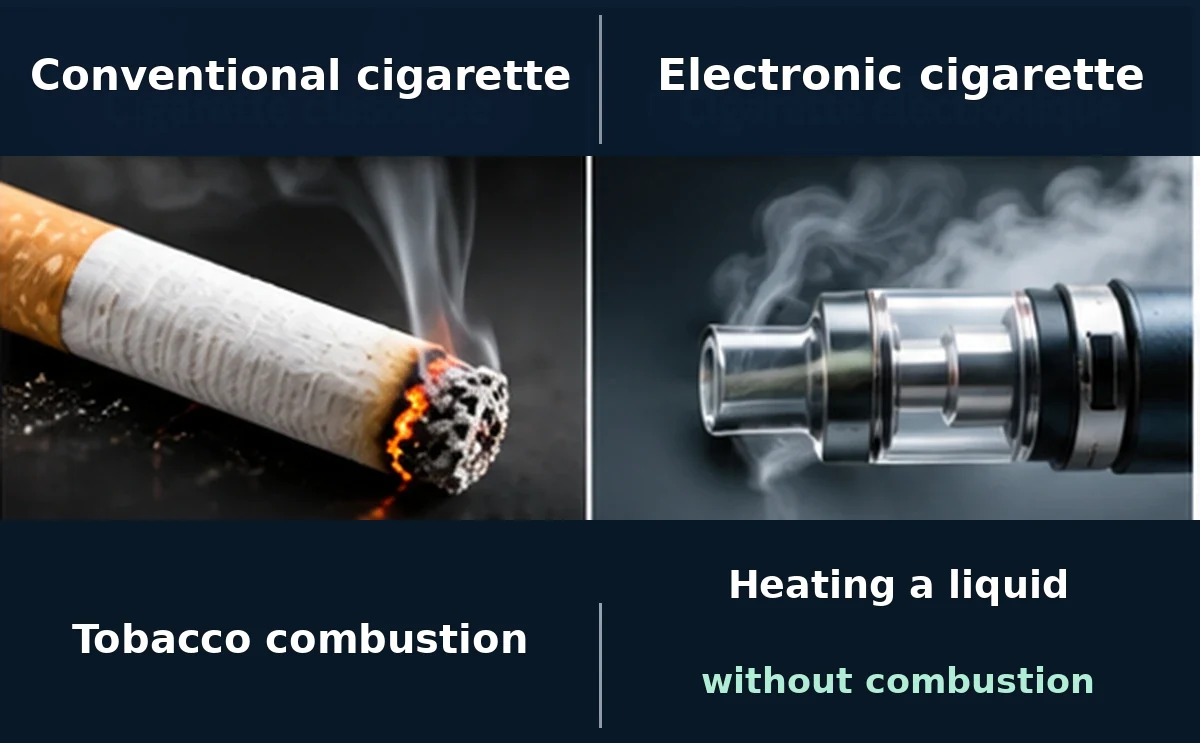
A conventional cigarette works by burning tobacco. This combustion produces smoke containing carbon monoxide, particles and numerous toxic or carcinogenic compounds.
An electronic cigarette works differently. It heats a liquid to produce an aerosol that the user inhales, without the normal combustion of tobacco.
This difference matters: a large proportion of the diseases associated with smoking result from repeated exposure to substances generated by combustion.
However, an e-cigarette aerosol is not simply water vapour. It may contain irritating or potentially harmful substances, including certain aldehydes produced during heating.
The absence of combustion is therefore a major difference between the two practices, but it does not make vaping harmless.
Is vaping less dangerous than smoking? Evidence on toxic substances
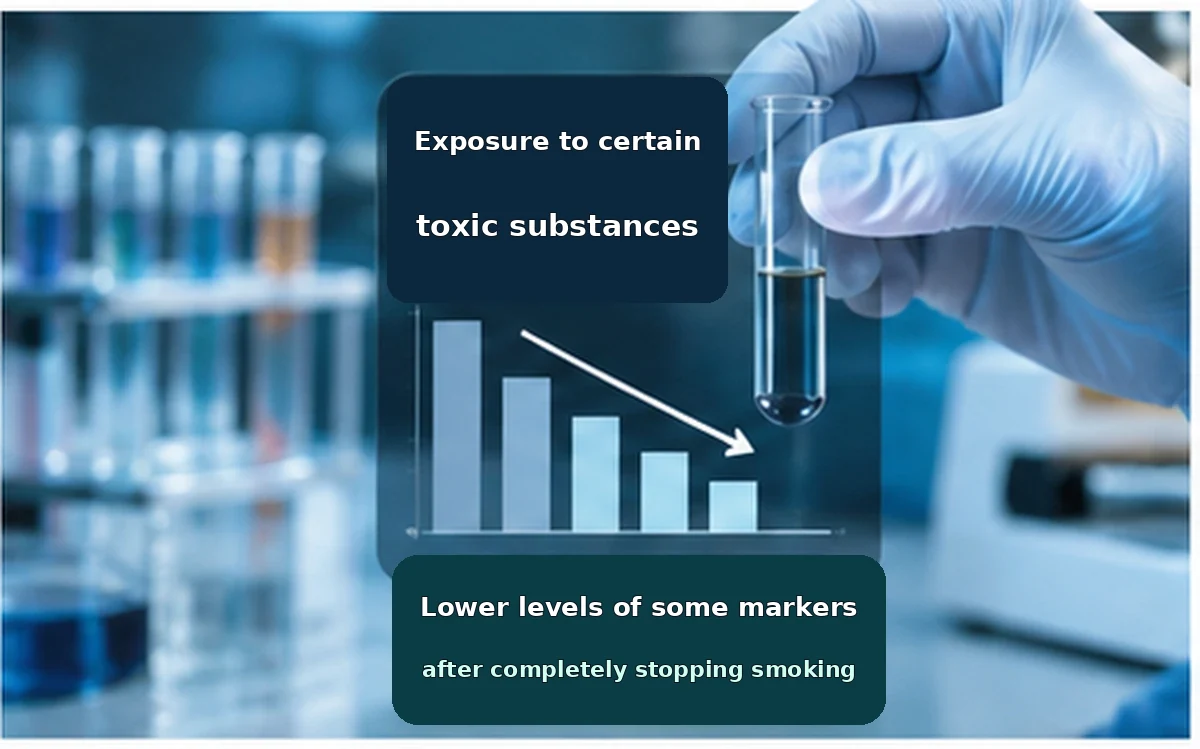
Researchers have compared substances detected in the bodies of smokers and people who use only electronic cigarettes.
A meta-analysis published in 2025, covering clinical trials, found that people who had completely replaced smoked cigarettes with electronic cigarettes had significantly lower levels of several markers of exposure to carcinogenic substances.
In particular, the authors observed reductions in eight of the substances or groups of substances studied.
Read the 2025 scientific study on PubMed
Another systematic review, published in 2026 and covering 60 human studies, also found substantial reductions in several biomarkers of exposure to tobacco and combustion toxicants after smoked tobacco had been replaced completely.
Read the scientific review published in 2026
These findings are important, but their scope must be interpreted correctly. They demonstrate reduced exposure to certain substances; on their own, they do not allow researchers to measure precisely how much the long-term risk of cancer or cardiovascular disease decreases.
E-cigarettes and smoking cessation: what Cochrane found in 2026
The independent scientific collaboration Cochrane regularly publishes systematic reviews bringing together the findings of clinical trials.
In its 2026 update, the review of electronic cigarettes for smoking cessation examined 80 randomised trials involving 29,861 participants.
The results show, with a high level of certainty, that nicotine-containing electronic cigarettes increase the chances of stopping smoking for at least six months compared with the nicotine replacement therapies assessed.
According to Cochrane's estimates:
- Out of 100 people using an electronic cigarette containing nicotine, around 8 to 10 might stop smoking for at least six months.
- Out of 100 people using nicotine replacement therapies, around 6 might achieve the same result.
These estimates relate to the conditions of the studies analysed and are not a guarantee of success for any individual.
Read the updated 2026 Cochrane review
The conclusion concerns vaping's effectiveness as a possible aid to smoking cessation among smokers. It does not demonstrate that prolonged use is free from harm.
The 2019 clinical trial: 18% quit compared with 9.9%
A study published in 2019 in the New England Journal of Medicine compared electronic cigarettes with nicotine replacement therapies in British stop-smoking services.
Participants also received behavioural support.
After one year, researchers observed:
- 18% tobacco abstinence in the electronic-cigarette group.
- 9.9% tobacco abstinence in the nicotine-replacement group.
The difference was statistically significant.
The study provides further evidence supporting the possible effectiveness of electronic cigarettes in certain attempts to stop smoking. It also highlights that a substantial proportion of participants who had stopped smoking were still vaping after one year.
Read the 2019 clinical trial by Hajek and colleagues
A 2024 study confirms the possible value for smoking cessation
Another randomised trial, published in the New England Journal of Medicine in 2024, examined adding electronic cigarettes to usual smoking-cessation care.
After six months, continuous abstinence from smoked tobacco, verified biologically, was recorded in:
- 28.9% of participants in the group receiving electronic cigarettes in addition to usual care.
- 16.3% of participants in the group receiving usual care.
However, stopping smoking must be distinguished from stopping all nicotine use. In this trial, abstinence from all nicotine was less frequent in the group receiving electronic cigarettes.
These findings illustrate the possible value of vaping for some people wishing to stop smoking, while also emphasising that ending nicotine dependence altogether is a separate goal.
Smoking and vaping at the same time: why switching completely matters
Studies on reducing exposure to toxic substances mainly concern people who have completely replaced smoked cigarettes with vaping.
Some people, however, continue to smoke while using an electronic cigarette. This is known as dual use.
Even when the number of cigarettes smoked decreases, exposure to smoke and combustion products continues.
It is therefore not possible to automatically apply findings from exclusive vapers to people who continue to smoke regularly.
In an attempt to stop smoking, the priority remains to give up smoked cigarettes entirely.
What does France's Anses say about vaping?
In its assessment published in February 2026, the French Agency for Food, Environmental and Occupational Health & Safety (Anses) highlighted health risks associated with inhaling vaping emissions.
The agency emphasises, in particular, that the absence of combustion does not prevent certain toxic substances from being formed or present.
Nevertheless, it considers that vaping may be considered as a temporary option for some smokers attempting to stop smoking, with the aim of stopping vaping as well in the longer term.
Read the Anses assessment published in 2026
French authorities recommend prioritising smoking-cessation methods whose effectiveness and benefit-risk balance are established, particularly validated treatments and support from healthcare professionals.
What conclusions can we draw from the scientific studies?
Research provides two main lessons.
First, completely replacing smoked tobacco with an electronic cigarette reduces exposure to several toxic substances associated with combustion.
Second, several clinical trials show that nicotine-containing electronic cigarettes can help some adult smokers stop smoking.
These findings do not mean that vaping is harmless. The effects over very long periods are still not fully understood, and nicotine can sustain dependence.
For someone who does not smoke, starting to vape offers no health benefit. For someone who smokes, the essential goal remains stopping tobacco use for good, ideally with support from a healthcare professional.
FAQ: vaping or smoking
Is vaping less dangerous than smoking?
Vaping avoids burning tobacco and may reduce exposure to several toxic substances when smoked cigarettes are replaced completely. This does not mean it is harmless or that all its long-term health effects are known.
Do scientific studies prove that vaping helps people stop smoking?
Several clinical trials and the 2026 Cochrane review show that nicotine-containing electronic cigarettes can increase the chances of stopping smoking for some adult smokers. Outcomes vary according to the individual and the support provided.
Is vaping dangerous for the lungs?
The aerosol may contain substances that irritate or potentially harm the respiratory tract. Current evidence does not rule out adverse effects after prolonged exposure.
Is it better to vape and smoke at the same time?
Dual use maintains exposure to cigarette smoke. Benefits observed in studies of complete tobacco replacement cannot automatically be applied to dual use.
Should someone who does not smoke start vaping?
No. A non-smoker gains no health benefit from starting to vape and may be exposed to irritating substances or develop nicotine dependence.
This article presents findings from scientific research for information purposes. It is neither an individual recommendation to vape nor medical advice. Anyone wishing to stop smoking can seek tailored support from a doctor, pharmacist or smoking-cessation specialist.