

Post author: Royalcig
Publication date: 22/11/2026
Can an electronic pipe work simply by drawing on its mouthpiece, without having to press a button? This question often comes up when looking into the different firing systems used by e-pipes.
Can an electronic pipe work simply by drawing on its mouthpiece, without having to press a button? This question often comes up when looking into the different firing systems used by e-pipes.
Most familiar electronic pipes, such as the Kamry K1000 Plus and several handcrafted Créavap models, use a firing button known as a switch.
However, electronic pipes with automatic activation have also been sold. Their distinguishing feature is that they detect inhalation and power the coil without the user pressing a button for each puff.
How does this system work? Which models have used it? How does it differ from a conventional e-pipe? Here are the main explanations.

1. What is an automatic e-pipe?
An automatic e-pipe is an electronic pipe in which the coil is activated by inhalation.
On a manually activated model, the user must press a button to establish or control the electrical power supply.
On an automatic pipe, a change in pressure or airflow allows the device to detect the user's draw.
This detection then activates the heating system, provided the operating conditions are met.
Three concepts should be distinguished:
- Automatic e-pipe: activation by inhalation.
- Button-operated e-pipe: activation by pressing a switch.
- Electronically regulated e-pipe: a device fitted with an electronic circuit that controls certain electrical characteristics.
A pipe may contain electronic components without necessarily working through automatic draw activation.
Similarly, the absence of a screen does not mean that a pipe is automatic.
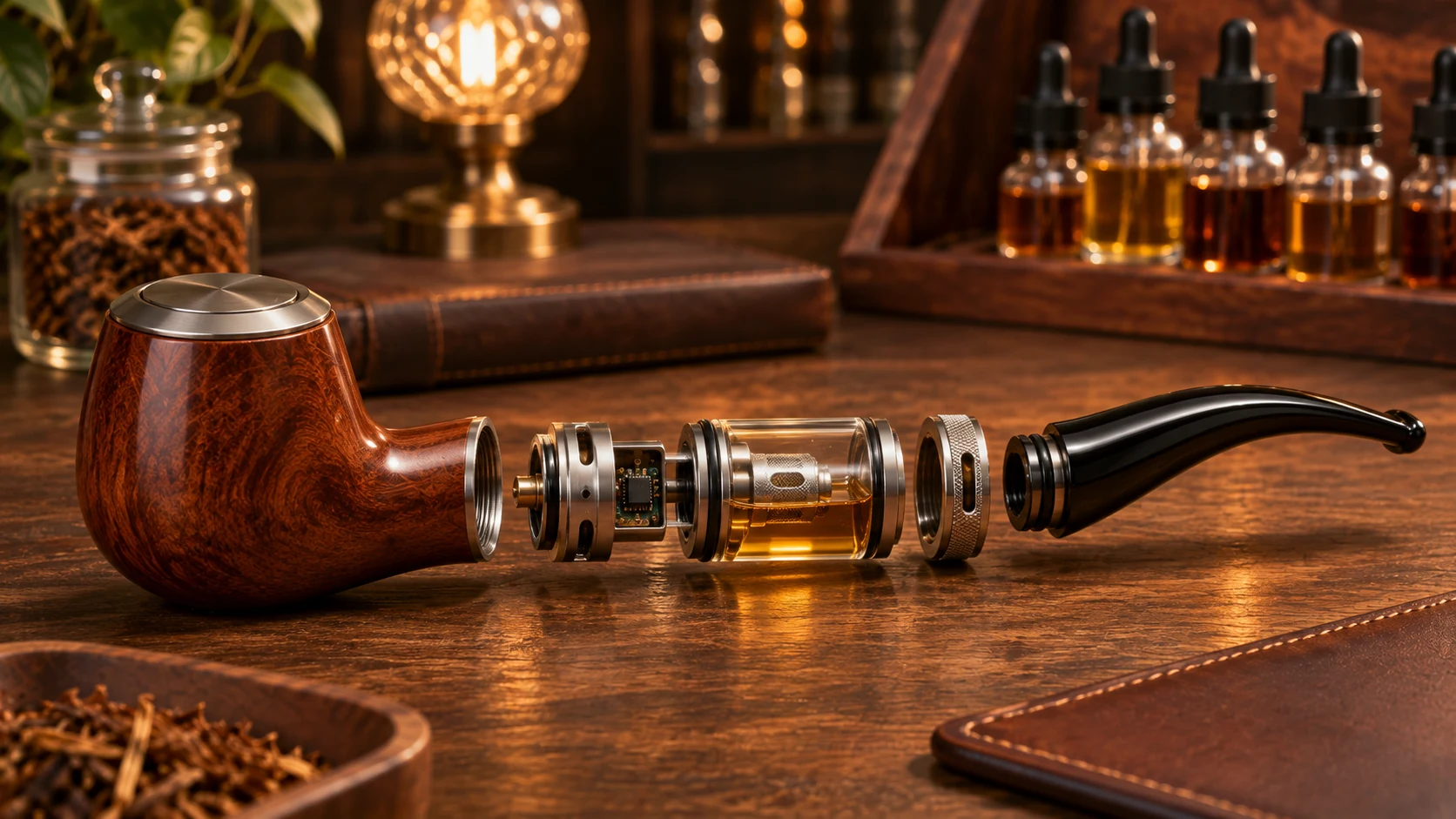
2. How does automatic draw activation work?
In an automatic electronic pipe, air flows through the mouthpiece and vapour-producing system when the user inhales.
This airflow creates a pressure change detected by a device built into the pipe's body.
Depending on the device's design, detection may rely on a pressure-sensitive mechanism or a sensor connected to an electronic circuit.
When the expected change is detected, the coil's power supply is activated.
The system generally involves several components:
- A built-in battery or rechargeable cell.
- An inhalation-detection system.
- A suitable electrical circuit.
- A compatible atomiser or clearomiser.
- An unobstructed airflow path.
The automatic function therefore concerns firing only. It does not remove the need for a battery or routine maintenance.

3. Which automatic electronic pipe models have existed?
Several manufacturers have offered e-pipes activated by inhalation.
The automatic 618 e-pipe
The 618 electronic pipe is among the models historically sold with this operating system.
Its product documentation describes a system in which inhalation operates a switch concealed inside the pipe's body.
The device included a battery, a tank and a mouthpiece designed to suit its construction.
It also featured a light inside the bowl that illuminated during inhalation.
This model illustrates a generation of electronic pipes whose operation relied on a relatively specific automatic system.
The current availability of the device and its replacement parts must be checked separately.
The Zen Pipe by VapeOnly
The Zen Pipe by VapeOnly is another documented example of a pipe with automatic firing.
It used an 18650-format rechargeable cell and a vapour-producing system built into its mouthpiece.
It was activated by inhalation, without requiring a button to be pressed during each puff.
These two examples show that the automatic electronic pipe is not merely a theoretical concept.
However, the characteristics of an older model should not be generalised to devices currently on sale.
4. Does the Kamry K1000 Plus work automatically?
No. The Kamry K1000 Plus uses a firing button located on the upper part of the pipe's body.
The user must press this button while inhaling to control aerosol production.
This operation is sometimes confused with that of automatic pipes, especially because the Kamry has a built-in battery and electronic controls.
But a built-in battery does not mean automatic firing.
The Kamry K1000 Plus also has indicator lights and electronic protections specific to its design.
Its operation must therefore be distinguished from that of a mechanical pipe or an older e-pipe fitted with a draw sensor.
To understand the different technologies, read our complete guide to electronic pipes.
5. Are Créavap electronic pipes automatic?
Several Créavap models, including certain Billiard, Bent and Dublin versions, operate with a manual switch.
On these pipes, the user presses the button to establish the electrical contact required for operation.
Some versions use an 18350 cell, while others are designed for an 18650 cell.
It is also important to distinguish mechanical models from versions equipped with electronic regulation.
A mechanical pipe does not necessarily have the protections found in an electronically regulated box mod.
Button operation and mechanical construction are two different characteristics: one concerns firing, while the other concerns the design of the electrical circuit.
6. What are the advantages and limitations of automatic firing?
Automatic firing primarily changes how the device is used.
The user does not need to hold down a button during each draw.
However, this system may have certain technical limitations.
The sensor depends on airflow and, depending on its design, may be affected by condensation, residue or a detection fault.
On some older models, repairs may also be complicated by the limited availability of replacement parts.
| Feature | Automatic e-pipe | Button-operated e-pipe |
|---|---|---|
| Firing | By inhalation | By pressing a switch |
| Button required during a puff | No | Yes |
| Air-detection system | Yes | Not necessarily |
| Risk of sensor failure | Possible | Not applicable if no sensor is fitted |
| Tank maintenance | Required | Required |
| Electrical precautions | Required | Required |
Neither system, on its own, guarantees greater reliability or a longer service life.
7. Why does an automatic e-pipe stop firing?
An automatic electronic pipe may stop responding to inhalation for various reasons.
Possible causes include:
- A battery that is not sufficiently charged.
- An obstruction in the airflow path.
- A build-up of condensation.
- A faulty coil or atomiser.
- A fault in the detection system.
- A problem with the electronic circuit.
When the device no longer responds, the first step is to identify the symptoms and consult the manual for the model concerned.
Cleaning should be limited to the accessible parts specified by the manufacturer.
Never insert a metal object into the sensor, blow compressed air into the mechanism or dismantle the electronic system in an attempt to force it to work.
Our article on electronic pipes that have stopped working explains the general checks to carry out for different types of device.
8. What precautions should be taken with an automatic electronic pipe?
An automatic e-pipe must be transported and stored in accordance with its manufacturer's instructions.
Abnormal firing, particularly when no one is inhaling, is a sign of malfunction requiring use to stop immediately.
If the device overheats, fires on its own or produces an unusual smell, stop charging it as well.
A damaged built-in battery or rechargeable cell must never be reused.
Mechanical button-operated models have other constraints, especially when their switch cannot be locked.
These differences are explained in our article about transporting electronic pipes and accidental firing.
Automatic firing never removes the need to follow electrical safety instructions or the specifications of the coil being used.
Frequently asked questions about automatic e-pipes
Yes. Models such as the 618 e-pipe and the VapeOnly Zen Pipe were sold with inhalation activation. Their current availability must be checked.
No. The Kamry K1000 Plus uses a firing button on the pipe's body. It does not operate solely through inhalation.
The term automatic describes the firing method. The term mechanical describes the design of the electrical circuit. They do not mean the same thing.
Firing without inhalation can occur if the device malfunctions. If this happens, stop using it immediately and have it checked.
Such a conversion would require modifying the firing circuit. It must not be attempted without appropriate technical design and validation, as it could remove protections or cause an electrical malfunction.
Conclusion
Automatic electronic pipes have indeed existed, and several models used a system activated by inhalation.
This operation must be distinguished from that of button-operated e-pipes, such as the Kamry K1000 Plus or several Créavap models.
Automatic activation changes the firing method, but does not eliminate maintenance requirements, battery ageing or electrical risks.
Before using an older model, it is important to check its condition, documentation and the availability of compatible components.
Electronic cigarettes are not risk-free. Nicotine is addictive.