

Post author: Royalcig
Publication date: 20/11/2026
A wooden electronic pipe has one particular characteristic: its body is made from a natural material that reacts to its environment. Unlike an entirely metal casing, wood may be sensitive to changes in humidity, liquids and extreme temperatures.
A wooden electronic pipe has one particular characteristic: its body is made from a natural material that reacts to its environment. Unlike an entirely metal casing, wood may be sensitive to changes in humidity, liquids and extreme temperatures.
On a handcrafted e-pipe, such as some Créavap models, the wooden body also houses electrical and mechanical parts. Maintenance must therefore take two aspects into account: preserving the wood and protecting the device's components.
How can you prevent moisture from damaging a wooden electronic pipe? What should you do if condensation appears or e-liquid leaks? Here are the essential precautions.
1. Why can moisture damage a wooden electronic pipe?
Wood is a hygroscopic material: it can absorb or release moisture depending on its surroundings.
Significant changes can cause slight dimensional variations in the material. Depending on the wood species, its finish and the conditions of exposure, warping or surface damage may occur.
A handcrafted electronic pipe is generally protected by an appropriate finish, but this protection does not mean it can be immersed or exposed to water for prolonged periods.
Moisture also poses a risk to the metal and electrical parts built into the device.
The main situations to avoid are:
- Prolonged exposure to water or a very humid environment.
- An e-liquid leak reaching the body of the pipe.
- Liquid entering the electrical connector.
- Storage in a location subject to large temperature fluctuations.
- Using cleaning products unsuitable for the wood finish.
The aim of maintenance is to minimise these situations without unnecessarily interfering with internal components.
2. Where does moisture on an e-pipe come from?
Moisture seen around an electronic pipe does not necessarily come from the wood.
Condensation in the mouthpiece
During use, some of the aerosol can condense on the cooler surfaces of the airflow channel or mouthpiece.
Small droplets may then appear, particularly in long mouthpieces.
This condensation is different from a leaking tank, although both can leave traces of liquid.
A leak from the clearomizer
A damaged seal, an incorrectly fitted coil or a tank with a sealing fault can cause e-liquid to leak.
The liquid can then reach the connection between the clearomizer and the pipe body.
This area deserves special attention because it may contain electrical contacts.
Humidity in the surrounding environment
A pipe left in a damp room, exposed to rain or stored in unsuitable conditions can also be affected by ambient humidity.
It is therefore important to distinguish external moisture from a problem originating directly in the vaporisation system.
3. How can you clean the wooden body without damaging it?
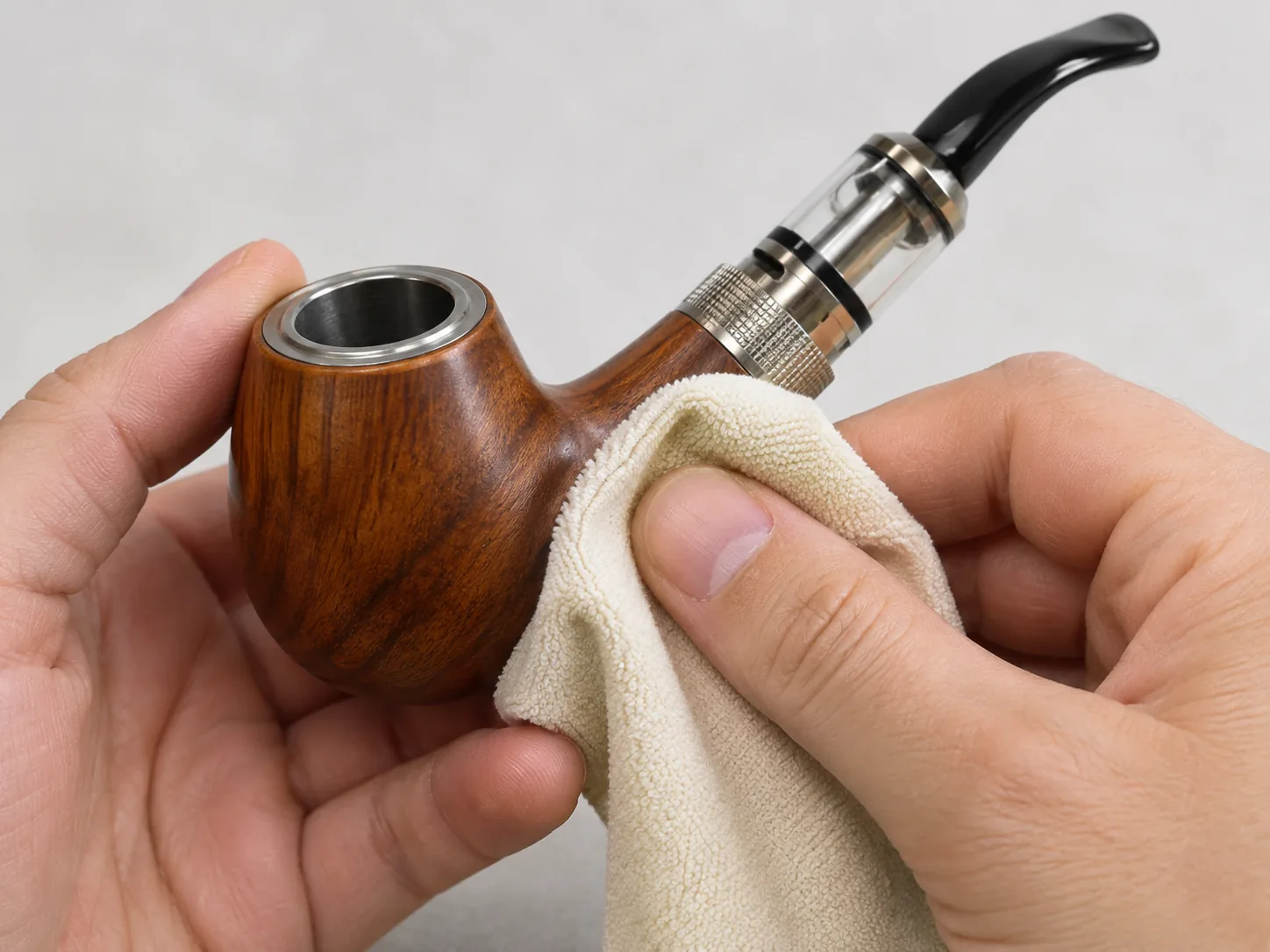
For routine maintenance, a soft, clean and dry cloth is generally suitable.
Wipe the outside surfaces gently to remove handling marks and dust.
Never immerse the body of an e-pipe in water.
Also avoid:
- Harsh household cleaning products.
- Solvents not recommended by the manufacturer.
- Abrasive sponges and stiff brushes.
- Steam cleaners.
- Drying immediately beside a radiator or another source of intense heat.
Some handcrafted pipes have a waxed finish, while others use different surface treatments.
Wax, oil or furniture-care products should therefore not be applied as a matter of course.
The maintenance treatment must match the model's actual finish and its manufacturer's recommendations.
4. What should you do if e-liquid spills onto a wooden electronic pipe?
When a leak occurs, it is important to identify its source before using the device again.
First stop using the pipe and switch it off if the model allows this.
Gently wipe liquid from the outside surfaces with a soft, lint-free cloth.
Then check, without dismantling electrical parts, whether the liquid appears to have come from the tank, a seal or the clearomizer connection.
If the device has a removable battery cell, remove it only when this can be done safely and in accordance with the instructions.
If liquid has entered the battery compartment, connector or electrical components, do not use the device again until it has been appropriately checked.
Simply drying the outside does not guarantee that liquid has disappeared from inside or that the components are in good condition.
Heating the device with a hairdryer or attempting an improvised repair is not recommended.
5. How can you prevent condensation and leaks around the connector?
On some e-pipes, the clearomizer is fitted directly above the wooden body.
The connection must remain clean and dry.
A few checks can help prevent problems:
- Visually check that there is no liquid around the connector.
- Check the condition of the clearomizer seals.
- Follow the tank-filling instructions.
- Avoid overtightening when screwing in an atomizer.
- Use only accessories compatible with the model.
- Clean removable parts according to their respective instructions.
A clearomizer that leaks repeatedly should be checked separately from the pipe body.
Never put cleaning liquid into the electrical connection or battery compartment.
To understand the different components of an e-pipe, also read our guide to how an electronic pipe works.
6. How should you store a wooden electronic pipe when not in use?
Storage plays an important role in preserving the materials.
Choose a dry, temperate and stable indoor environment, away from direct sunlight and sources of heat.
In particular, avoid leaving an electronic pipe:
- In a car exposed to sunlight.
- On a windowsill where condensation forms.
- In a very humid bathroom.
- Near a radiator.
- In a damp case or one showing traces of liquid.
When the pipe is to be stored for a long period, follow the manufacturer's instructions on switching off the device, storing the battery cell and removing accessories where necessary.
For a mechanical e-pipe with a removable battery cell, transport and storage precautions are especially important, particularly when the firing button has no lock.
Removed battery cells must be kept in a suitable insulating case.
7. How can you recognise a damaged wooden electronic pipe?
Natural wood changes over time. A moderate change in colour or patina does not necessarily indicate deterioration.
However, certain changes should attract attention:
- A new crack in the wooden body.
- Visible swelling or distortion.
- A finish that peels or deteriorates unusually.
- Persistent traces of liquid around the connector.
- Corrosion on accessible metal parts.
- A button or mechanism that has become unusually difficult to operate.
A change in the appearance of the wood does not necessarily mean that an electrical component is faulty.
However, if damage appears near the battery compartment or firing mechanism, it is preferable to stop using the device and seek technical advice.
Do not attempt to sand, glue or modify the body of an e-pipe if doing so could affect its connections or electrical operation.
8. Does a Créavap e-pipe need special maintenance?
Handcrafted Créavap electronic pipes can be made from different wood species, including walnut, zebrano or wenge, depending on the model.
The finish and exact design vary from one product to another.
Maintenance must therefore be adapted to the particular pipe rather than following a universal method.
For Bent, Billiard, Dublin and Gandalf models, the general precautions remain similar: protect the body from excess moisture, keep the connections dry and maintain the clearomizer separately.
It is also important to distinguish mechanical models from those with regulated electronics.
To learn about the characteristics of different designs, you can find technical information in our e-pipes section.
Frequently asked questions about moisture and wooden electronic pipes
Can you clean a wooden electronic pipe with water?
Do not immerse the wooden body or electrical components. A soft, dry cloth is generally suitable for the outside. Removable clearomizer parts should be maintained separately according to their instructions.
Why does moisture appear in an e-pipe stem?
Some of the aerosol can condense when it touches the cooler surfaces of the mouthpiece. Droplets may then collect in the airflow channel. You should also check that the tank is not leaking.
Can you apply wax to a wooden electronic pipe?
That depends on the finish. Some models are waxed, but not all e-pipes need the same care. Use only a product recommended for your model and avoid any contact with electrical parts.
What should you do if a wooden electronic pipe has been caught in the rain?
Stop using it and gently wipe accessible surfaces. Do not heat it to speed up drying. If water may have entered the battery compartment or electrical connections, have the device checked before using it again.
Can a wooden electronic pipe crack because of humidity?
Wood can react to significant changes in humidity and temperature. Depending on its type and finish, those changes may contribute to warping or cracks. A crack near electrical parts requires inspection before use.
Conclusion
A wooden electronic pipe needs maintenance that respects both the characteristics of the natural material and the requirements of its electrical components.
The best prevention is to avoid liquid ingress, watch for possible clearomizer leaks and store the device in suitable conditions.
Gentle external cleaning and following the manufacturer's recommendations help limit risky handling.
When there are traces of moisture in the connections or visible damage, caution is essential: stopping use and having the device checked is preferable to attempting an improvised repair.
RoyalCig technical information article intended for adults. Vaping products are not risk-free. Nicotine is addictive. These products must not be used by non-smokers.