
Post author: Royalcig
Publication date: 20/11/2026
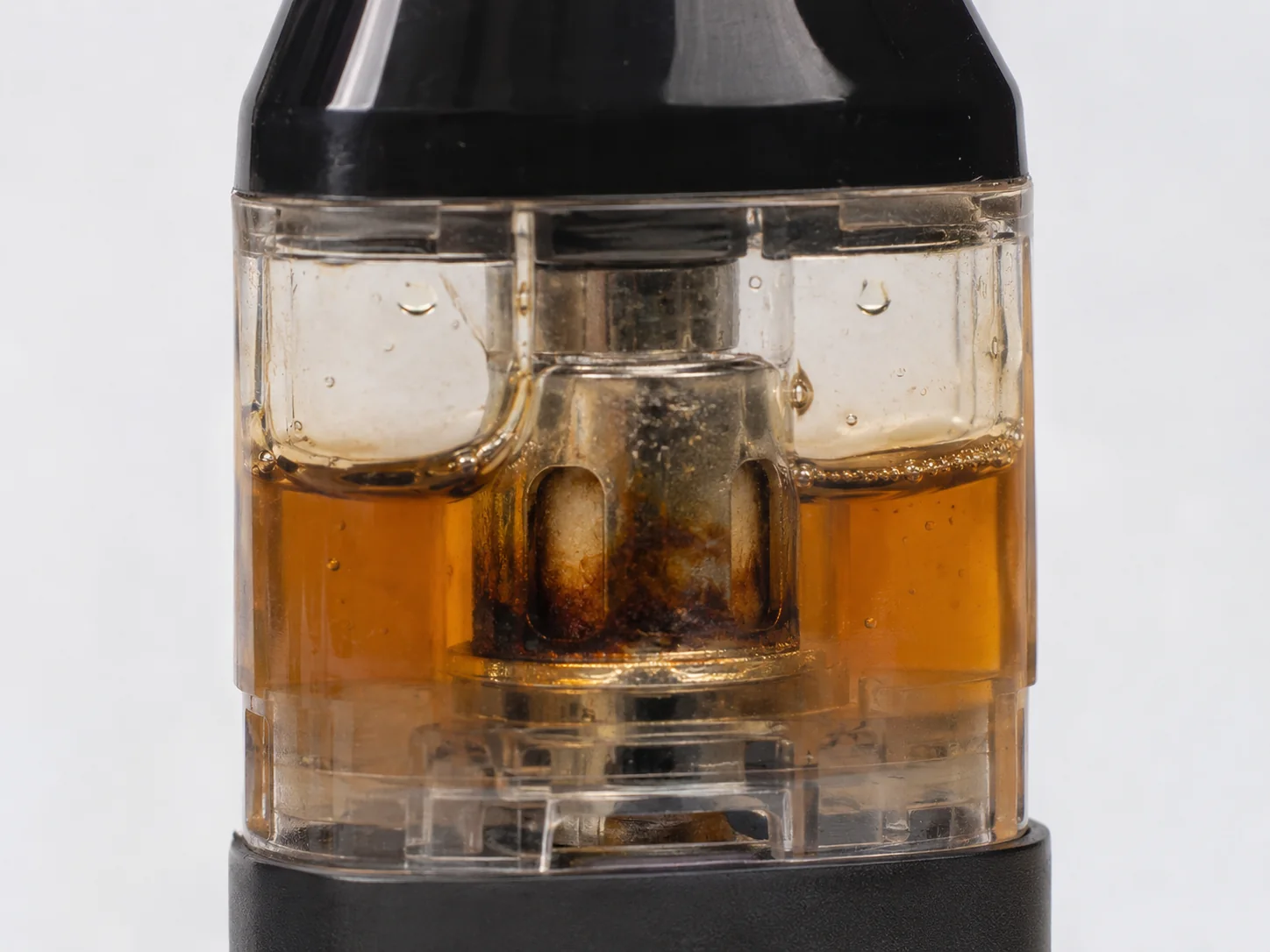
You filled your electronic cigarette with a clear e-liquid, but after several uses it turns dark yellow, amber or brown. Sometimes the change is gradual. In other cases, it happens quickly, while the liquid kept in its bottle has not changed colour.
You filled your electronic cigarette with a clear e-liquid, but after several uses it turns dark yellow, amber or brown. Sometimes the change is gradual. In other cases, it happens quickly, while the liquid kept in its bottle has not changed colour.
Why does e-liquid turn brown in the tank? Several processes can explain this colour change: oxidation of certain ingredients, heat, residue building up on the coil, or the liquid's flavouring composition.
Colour provides a clue, but it cannot on its own determine the condition of the product. Here is how to understand the possible causes and identify situations that need checking.
1. Oxidation can change the colour of e-liquid
Oxidation is a chemical reaction that can occur when certain e-liquid ingredients come into contact with oxygen.
Nicotine in particular can undergo changes during storage and use. A liquid that was initially clear or slightly yellow may therefore take on a darker shade over time.
This change depends on several factors:
- The composition of the e-liquid and its nicotine concentration.
- The length and conditions of storage.
- Exposure to air and light.
- The temperature to which the liquid is exposed.
However, a colour change does not necessarily mean that the nicotine has oxidised. Other ingredients may also be involved.
2. A dirty coil can darken the liquid in the tank
An electronic cigarette's coil heats the liquid absorbed by its wick, which is generally made of cotton.
Over time, residue can form on the heating surfaces and in the absorbent material. Certain flavouring ingredients and sweeteners may contribute to this build-up.
Some of these substances may then enter the surrounding liquid and affect its colour.
Several signs may accompany this process:
- The liquid quickly becomes darker near the coil.
- Brown or black deposits are visible.
- The usual taste changes.
- A burnt taste appears.
- Vapour production changes noticeably.
These observations may indicate a dirty or damaged coil, but they are not always enough to establish a definite diagnosis.
3. Why does the liquid turn brown in the tank but not in the bottle?
This difference is a particularly useful clue.
In its closed bottle, the liquid is not normally exposed to the repeated heating cycles that occur in an electronic cigarette.
Conditions in the tank are different: the liquid is close to the coil, may be exposed to light and comes into contact with the internal components of the vaporisation system.
Residue from the heating area may also gradually mix with the remaining liquid.
If the liquid in the bottle retains its original colour while the liquid in the tank quickly turns brown, the condition of the coil and the cleanliness of the tank should be checked in particular.
However, this does not rule out other causes related to the liquid's composition or the conditions of use.
4. Can flavourings explain why an e-liquid is dark?
Not all e-liquids have the same colour to begin with.
Some formulations are clear, while others naturally have yellow, amber or brown tones.
Complex flavouring blends, particularly those reminiscent of coffee, vanilla or certain sweet and classic tobacco profiles, may contain ingredients that influence their colour.
The shade can also change during storage.
A dark e-liquid should therefore not automatically be considered degraded, nor should a clear e-liquid be assumed to be of better quality.
Colour should be assessed in light of the product's original appearance, its history and any other changes observed.
5. Can temperature speed up browning?
Heat promotes certain chemical reactions and can accelerate changes in sensitive ingredients.
In an electronic cigarette, the liquid close to the coil is regularly exposed to temperature variations.
An unsuitable power setting, an insufficient supply of liquid to the wick or activations in very quick succession can increase thermal stress.
To limit malfunctions, it is important to follow the operating ranges specified by the manufacturer.
You should also avoid leaving a bottle or an electronic cigarette in direct sunlight, especially behind glass or inside a hot vehicle.
6. Can brown e-liquid still be used?
Colour alone cannot guarantee that an e-liquid is safe.
Slight darkening may be related to known chemical changes. However, appearance does not provide precise information about the substances present, their concentrations or any degradation products.
It is best not to use a liquid when an unusual change is accompanied by signs such as:
- An abnormal smell or one that is very different from the original.
- Unexplained particles or deposits.
- Unusual separation that persists.
- Suspected contamination.
- Significant heat exposure or unknown storage conditions.
If you are unsure about the liquid's condition, it is safer not to use it. If the device is not working normally, stop using it as well and consult the manufacturer's instructions.
7. How can you identify the cause of the colour change?
Before doing anything, switch off the device and allow the components to cool down.
Step 1: compare the bottle and the tank
Look at both liquids under similar lighting.
If only the liquid in the tank has darkened, the coil and conditions of use deserve particular attention.
If the contents of the bottle have also changed colour, look instead at their age, composition and storage conditions.
Step 2: check the condition of the coil
Look for visible deposits, changes in taste or signs of overheating.
If the coil is damaged or shows signs of wear, replace it with a compatible model in accordance with the instructions.
Step 3: inspect the tank
Check for any residue on the walls and around accessible parts.
Clean only the parts the manufacturer says can be cleaned in this way. Never immerse a battery or electronic component in water.
Step 4: check the power setting
If your device allows you to adjust the power, make sure it matches the coil manufacturer's recommendations.
Excessive heating can encourage degradation processes.
Step 5: monitor changes
After appropriate maintenance, compare the liquid's appearance with the liquid in the original bottle.
If browning returns very quickly, especially with a new coil, it may be helpful to have the device checked by a qualified professional.
8. How can colour changes be limited?
A few maintenance and storage practices can reduce certain causes of browning:
- Keep bottles tightly closed, away from light and excessive temperatures.
- Follow the manufacturer's recommendations for the coil.
- Replace consumable parts when they show signs of wear.
- Clean compatible parts of the tank according to the instructions.
- Avoid continuing to use a device that produces a burnt taste or overheats unusually.
These measures cannot prevent all chemical reactions. E-liquid may change naturally even when stored under good conditions.
Frequently asked questions about brown e-liquid
Why does my e-liquid turn brown after just a few puffs?
Rapid browning in the tank may be associated with residue on the coil, thermal processes or certain characteristics of the liquid. Check the coil's condition in particular and compare the colour with the liquid in the bottle.
Can nicotine-free e-liquid turn brown?
Yes. Nicotine is not the only ingredient that can affect colour. Certain flavouring blends and changes caused by heat or ageing can also alter the appearance of nicotine-free liquid.
Do I need to change the coil when the liquid turns dark?
Not necessarily. However, heavy deposits, a burnt taste, damaged cotton or abnormal performance may justify replacing it.
Why does my e-liquid turn orange instead of brown?
Processes that change colour can produce several shades, ranging from yellow to orange or brown. The exact shade depends, among other things, on the formulation. It is not enough to identify a chemical reaction precisely.
Is e-liquid that has turned brown dangerous?
It is not possible to determine whether it is harmless simply by looking at its colour. An unusual change should be treated with caution, particularly if accompanied by an abnormal smell, particles or signs of overheating. If in doubt, do not use it.
Conclusion
E-liquid turning brown in the tank does not necessarily indicate a fault. Oxidation, flavourings, heat and residue from the coil can all contribute to this change in appearance.
The first check is to compare the liquid in the tank with the liquid kept in the bottle. This observation helps guide the diagnosis.
Because colour is not a reliable indicator of safety, any unusual change should be approached cautiously, especially if it comes with a change in the smell or operation of the device.
RoyalCig technical information article. Vaping products are not risk-free. Nicotine is addictive. These products are intended for adults and should not be used by non-smokers.